

In the world of costume design, authenticity is paramount, especially when bringing a complex sci-fi series like 3 Body Problem to life. Renowned costume designer Michael Wilkinson, known for his work on iconic projects such as Tron: Legacy, American Hustle, Justice League, and Andor delves into the intricate process of creating realistic and engaging costumes for the highly anticipated Netflix series. In this exclusive interview, Wilkinson discusses the challenges and triumphs of designing for multiple eras, his collaboration with the show’s creators, and how he and his team achieved a seamless blend of historical accuracy and futuristic vision in the 3 Body Problem costumes.
Spencer Williams: I am happy to talk with 3 Body Problem costume designer Michael Wilkinson again. Michael, it’s so good to see you.
Michael Wilkinson: It’s great to talk to you again. Thank you for your interest in 3 Body Problem.
Spencer Williams: Of course. Well, it’s such an exciting show. Let’s start from the beginning. 3 Body Problem is based on The Three-Body Problem by Chinese science fiction author Liu Cixin. How familiar were you with the story? I admittedly had never heard of it until I started watching this series, and now I just want to take a huge deep dive.
Michael Wilkinson: Well, the same is true for me. I hadn’t heard of it, but when I heard about the project and read the scripts, I was dazzled by their originality. I never read anything like it. And, of course, my interest was immediately piqued. How do you pull that off as a show? Writing it down in a book is one thing, but what does that look like on screen? What does that world look like? Well, the worlds, because so many are described in the book.

Spencer Williams: One thing I love about 3 Body Problem is the complexity of it all. So, how did you bring authenticity and groundedness to the story through the costumes? There are a lot of characters.
Michael Wilkinson: I’m happy you raised that question because authenticity was at the top of my mind every day I went to work. I knew we couldn’t pull it off if there were any clichés, tropes, or easy answers—things we hadn’t thought about. There were so many pitfalls we could have fallen into. The only thing that could have saved it was for the audience to care deeply about the characters. That’s something we wanted to develop from the novel. We tried to avoid it being just a science lesson. We wanted to make sure you cared about these people.
And, you know, that’s a challenge in lots of ways. Designing for contemporary stories can be challenging because you can’t get away with anything. There’s nowhere to hide. We all know what people from our world look like. We know the difference between a $5 Hanes T-shirt and a $200 Comme des Garçons T-shirt. When doing period films, you can be the expert and show what the world looked like. But contemporary is challenging. So, I wanted to think about these characters and how they tried to present themselves to the world. I wanted to get into their insecurities, good and bad days. And there are plenty of bad days in season one. I wanted to go deep with that and have people connect with these characters.

At face value, these five young people are all super brainy scientists. And it’s like, “Oh, how do we connect with that?” But it was important to show them as real people with flaws and triumphs. Also, distinguishing between the five of them—the Oxford Five—was important. They all studied together but went in different directions after they studied. I wanted to define that with their looks.
For example, Jess Hong plays Jin, who lives inside her mind. I think she only thinks a little about or cares little about how she presents herself. She wants to be comfortable and taken seriously but isn’t preoccupied with projecting anything specific with her clothing. As the heart of the story, her character needed a slight neutrality so her look wasn’t too strong in any particular direction. I wanted everyone to connect with her.
Then we have Saul, a bit of a slacker, cruising through life and not applying himself. His clothes had that baggy, loose swagger. Raj, a key character, isn’t one of the five but is in the Navy. So, he has a very professional, serious, conservative vibe to his look. John Bradley’s character, Jack, is a super cocky young billionaire who recently came into a lot of money and wants everyone to see it. He has fun with fashion and clothes, probably has more money than style, and wants the most expensive sneakers and tracksuits he can buy at Harrods. That was fun to put together.

Eiza González’s character, Augie, is more of an applied scientist. She lives in the real world, solving real issues with physics. She dresses professionally and heads up a significant team at her nano center. Alex Sharp plays Will, a high school physics teacher. We didn’t think he’d be super focused on his clothing, but we wanted him to have an easy, comfortable vibe.
All these details went into creating very authentic characters that we could relate to, care about, and listen to their stories as they carry us through this complicated storyline.
Spencer Williams: You’re no stranger to sci-fi and these exciting worlds. When it comes to contemporary clothing, there is nowhere to hide. Even if a character has a good or bad day, you still have to portray that through the character and costume. This series was headed up by David Benioff, D. B. Weiss, and Alexander Woo. What was your collaboration like with the show creators?
Michael Wilkinson: I was so excited about working with these guys. David and Dan changed how we watch TV with Game of Thrones, with its incredibly complex, layered storytelling and a million characters they managed to pull off. With this story, I knew they would want not just to repeat that but go somewhere else and show the world they could do something equally incredible but in a completely different way. I was very interested in what they had to say about the sort of show they wanted to do. We discussed creating a very intelligent, modern type of storytelling that makes people pay attention and do a little work. It wouldn’t be an easy ride, but it would raise some fascinating, challenging questions about the universe, our role in nature, and the different value systems humans have set up.

The things we want to discuss with the show are quite massive. Trying to help tell that story through the costumes was hugely challenging. We go to these different worlds—the contemporary world, which spans the planet, and then flashbacks to the Cultural Revolution in China in the ’60s and early ’70s. Plus, there’s this game created by an alien race to help them solve their environmental problems.
Spencer Williams: That leads me to what I wanted to talk about—the research. Looking at all the different worlds, there’s so much in 3 Body Problem. As you mentioned, they go everywhere, from the Shang Dynasty to 13th-century Mongolia, Tudor England, and 16th-century Italy. How did you and your team get all these details correct? That’s a lot. Most shows cover just one of these areas, but you had to cover all of them.
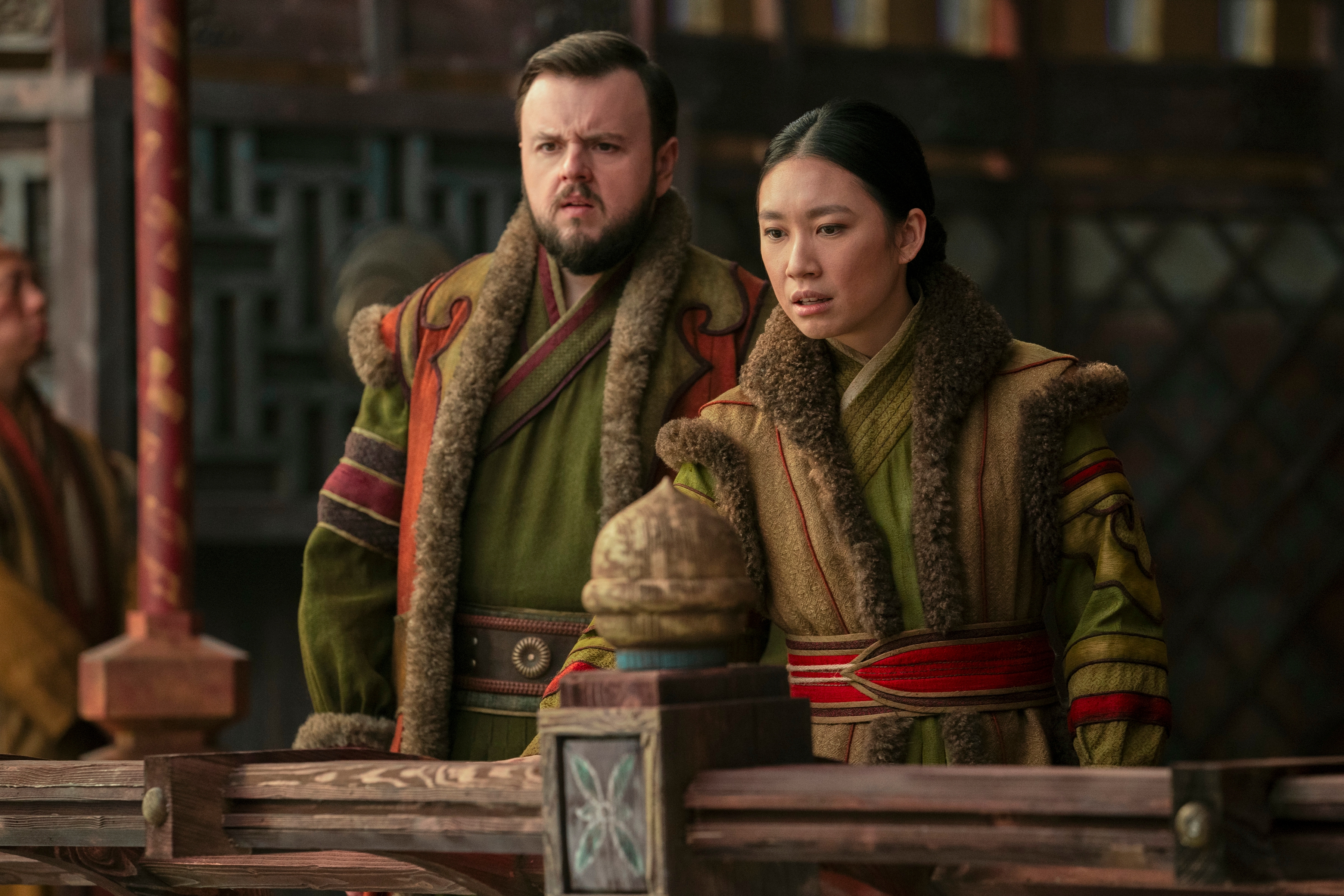
Michael Wilkinson: Yeah, it was a challenge. When you cover just one period, it’s like, okay, I’ve got this. I know the silhouette and how to achieve that. Then, you move on to another one. It was challenging because not only were we trying to be very authentic to these different periods, but we also had to think about the available textiles, how they were woven, what materials they had, and how things were constructed, whether it was 400 BC or 13th-century Mongolia, as you said.

So, all the research you usually do on a period film, but times six or seven, then there’s the layer of, okay, it’s a game created by another race, so it should feel highly authentic, yet it’s virtual reality. Very strange things happen—you’re not just recreating ancient China; you have a China where there’s a solar eclipse, zero gravity, and everyone dehydrates and then rehydrates. What does that world look like?
We knew it had to be sophisticated because the alien technology is so advanced. They can make it feel real. You can feel every grain of sand, touch the costume, smell the costume, and feel how the scratchy wool feels against your skin. All that was important. But then, at the same time, we have characters with contemporary hairstyles, glasses, and earrings. We always wanted the audience to know that it wasn’t just a simple period recreation; it was a different type of reality.
Spencer Williams: It’s not time travel; it was in a video game. I think that’s the difference.

Michael Wilkinson: Exactly. Yeah, and that was something I’d never done before. Another thing I’ve never done before is create a character like Sophon. A character named Sophon, played by Sea Shimooka, represents the alien race. They made her palatable to humans, something we can relate to and not be freaked out by. She guides the players through the game. So it’s like, okay, what does that look like? We had no idea. We went through a million different iterations. We wanted to avoid any video game clichés. We knew it had to be simple, iconic, memorable, and strong but not too scary. That was a unique challenge that I enjoyed trying to crack.

Spencer Williams: You all were balancing a fine line throughout this. Speaking of, there was another part of the show I want to talk about. As you mentioned, part of the series focuses on the Cultural Revolution in China in the ’60s and ’70s. How did you approach this period regarding the costumes and research? It’s more delicate, and you want to get the details right.

Michael Wilkinson: That’s spot on. It’s a sensitive period in history, and getting access to imagery from that period is quite challenging. It’s easy to see the state-sponsored propaganda and the images pushed out by the state, but as you go deeper and look at individual photographers and read about the experiences there, you get a better sense. We wanted to do justice to that and portray as much as we could understand what was happening then. So, it involved lots of reading and research into photographers.
Then, we had to create the costumes from scratch in the UK—which involved sourcing materials and reading about the limited materials available and how they were used. For example, silks were inappropriate because dressing in the old way wasn’t kosher. It was all about dressing for the future. There was a sense of uniformity, as everyone was equal, but how did people find avenues of self-expression within that? It was utterly fascinating. I could have done a whole project just on that. That was about 70 percent of the project and then everything else. It was a fascinating voyage to go on.

Spencer Williams: There are a lot of costumes. I have to imagine you must have had a pretty robust crew. Can we talk about your crew for a moment?
Michael Wilkinson: Yeah, let’s talk about my fantastic crew. I was very fortunate to have an incredibly supportive, experienced professional team. We were all based out of Shepperton Film Studios outside of London. I had about three main assistants, each doing different things. One was handling the principals, another was the game stuff, and the third focused on the Cultural Revolution in China. We also had people looking after all the crowd costumes—sourcing them, putting them together, and building them if they didn’t exist. And, of course, there was the incredible team who looked after our actors on set, ensuring everything looked the way it should and that the actors were happy and comfortable.

There were many challenges, like shooting in the middle of July at the UN Plaza, where everyone was melting because of the heat, but wearing costumes supposed to be bulletproof canvas. My team helped us glide gracefully through all sorts of logistical issues. Then, of course, there are the people who source the fabrics, the buyers, and all the accessories. We had an incredible aging and dyeing team. Once we made all those pieces, hundreds of pieces for the Cultural Revolution in China, they had to look incredibly worn, aged, and repaired. We busted things apart and did our repairs repeatedly to get that right level of authenticity.
It was a healthy-sized team, and I’m grateful to them for helping me complete this enormous task.
Spencer Williams: It’s enormous. Could you even guess how many costumes there were?
Michael Wilkinson: We dressed thousands of extras. It was one of the most extensive extras shows I’ve ever done. Each costume had to fit within over 50 different script days, so they added up.
Spencer Williams: What do you hope the audience takes away from this series, seeing your costumes and getting to know these characters?
Michael Wilkinson: I’d like the audience to pause and consider the big questions. What is our place in the universe? How do we treat each other? What are the value systems we’ve set up to live by? That’s what this story is all about. Yes, it’s the possibility of an alien race invading or coming to our planet, but what does that knowledge bring out in us? By our reactions to that news, what does it say about us and how we see ourselves in the world?

It’s very lofty thinking, but I think the role of good entertainment and good art is to ask us these important questions about ourselves. Expect the unexpected, and enjoy the ride. The show is visually interesting and surprises me all the way. It’s intelligent adult entertainment that makes you think. However, thinking about some big ideas is essential to the people who created them.
Spencer Williams: I can’t wait to go back and re-watch the show. Costume designer Michael Wilkinson, thank you so much for joining me. This was such a joy; hopefully, we will talk again soon.
Michael Wilkinson: It’d be great to talk to you again. Thank you for your time.

