

In a galaxy not so far away, costume designer extraordinaire Jennifer Bryan invites us behind the scenes of Star Wars: The Acolyte, revealing the secrets and inspirations behind the stunning costumes of this new chapter in the Star Wars saga. From the royal ascension robes of Mother Aniseya to the intricately detailed Jedi attire, Bryan shares her journey of sourcing rare fabrics, fitting towering Wookiees, and infusing vibrant colors and diverse cultural influences into the costumes. Join us as we delve into the meticulous craft that brings the rich tapestry of Star Wars to life, one stitch at a time.
Spencer Williams: I am so happy to welcome to The Art of Costume, the costume designer for The Acolyte and so much more, Jennifer Bryan. Hey, Jennifer!
Jennifer Bryan: Thank you for having me, Spencer!
Spencer Williams: Of course. Let’s finally get into The Acolyte costumes. First of all, this is your first step into the Star Wars universe. Were you a fan of Star Wars beforehand?
Jennifer Bryan: Oh yeah! Most people on the planet, if nothing else, have seen it. They know of the shows and principal characters. It’s been around so long that we even use phrases directly from Star Wars. One of the favorites is when someone says, “You’re going to do a Jedi mind trick on me.”

Spencer Williams: Were you excited, a little nervous? What were your initial thoughts?
Jennifer Bryan: I was over the moon. It’s the type of project I’ve always wanted to do. I wanted to dig deep into costume design and start from scratch, creating imaginative designs. Even though there is a Star Wars galaxy box, this timeline is a hundred years before, so it’s like a prelude. That gave me an opportunity to be more expansive in design, bringing in ideas and thoughts that you might not have seen in Star Wars before. However, I had to maintain a design thread that connects back to the galaxy. When viewers see it, it should feel fresh but familiar. It was a challenge, but I was very excited to do the show. I’m thrilled I got the opportunity.
Spencer Williams: We were all excited to see it and continue to as more episodes come out. As you mentioned, we’re exploring an age we haven’t seen on screen before. What did your research and preparation look like for The Acolyte costumes, considering it’s something we haven’t seen before? You got to play outside the box a little bit.
Jennifer Bryan: Yes, I did take advantage of that. My research went pretty far afield. I looked at ancient cultures globally—Himalayas, Gobi Desert, Pacific cultures, Japan, especially feudal Japan, Byzantine, Roman, and definitely all of the African continent. From north to south, the ancient cultures in Africa were particularly inspiring. I really went outside the traditional Anglo-Saxon research that you might use for a show like this.

Spencer Williams: As you got into The Acolyte costumes, tell me about your collaboration with showrunner Leslye Headland. What did that look like?
Jennifer Bryan: That was one of the most collaborative experiences I’ve had. Leslye was very approachable and open to the ideas I presented. She was always welcoming at my fittings. Sometimes, when working on particular things that reached a certain stage, I’d ask her to come over and look at the actor in the clothing before we finished it. She always made herself available, despite being very busy. Leslye had an open-door policy, which was incredibly helpful. Using that communication time with the director and showrunner as a tool really influenced what I was trying to present and make happen.
Spencer Williams: That’s very exciting. So I think it’s time we talk about some specific costumes from The Acolyte. I was immediately drawn to Mae—the use of textures looks like something we haven’t seen before in Star Wars. I mean, of course, there are lots of great textures and colors throughout Star Wars, but when I saw Mae in that first episode, I was immediately drawn to her. Could you elaborate on the materials and design elements used in Mae’s costume to reflect her warrior persona and nomadic lifestyle?

Jennifer Bryan: You nailed all the key points in her description. The purple cloak she wears in episode one is very dramatic as she walks into town on the hunt. She has a hit list in her head and no fixed address, so she’s absolutely nomadic. I wanted to show that in her clothing because she’s lost her family, her childhood, her community, which was burned down. She blames the Jedi, so she’s going after them.
We approached her outfit with the idea that she had assembled and stitched it together herself. She has no assassin store to shop at. The purple cloak was constructed with different types of hand-woven and open-weave cottons. We laid it out like a map and then created the robe. For those into costume construction, the bottom half of her cloak uses lighter weight cottons and more open weave, so as she walks, it flows behind her and doesn’t cling to her body. As we go from the waist up, the fabrics gradually get heavier. By the time we get to the cloak and hood, it’s a tighter weave to stay on her head and hold its shape.
Spencer Williams: Your own little Jedi costume trick.
Jennifer Bryan: Yes, my own Jedi mind costume trick. The purple color relates back to the Ascension ceremony when her life changed drastically. It’s a memory color, a connection to her childhood. The breastplate, which is her protective armor, features strips of bamboo stalks. This design was inspired by Samurai warriors from feudal Japan, where bamboo was used for its strength, sometimes as strong as steel. The metal plate reflects Byzantine or Roman emperors’ armor from the medieval age, used as protective material for the chest and upper body.

We can also talk about the chain mail. Notice it’s been through a lot.
Spencer Williams: I was going to ask you about that. It looks like there’s a lot of aging and dying happening in The Acolyte costumes, making them look very broken down.
Jennifer Bryan: Very, very broken down. We took apart so many links from the chain mail. It’s a challenge to dismantle chain mail deliberately and then have it drape on the body and look right. We strategically removed links to create tears and holes, emphasizing that she’s on a mission and has assembled her outfit from things she’s found along the way. Design-wise, we referenced classic Jedi attire with a leather belt, a reverse mirror to the Jedi Knights’ belts. Instead of a symbol, the rings on her belt are the handles of her single-blade knives. They look like decor but are functional. She has knives concealed all over her body—in the belt, gloves, and back, ready for use.
Spencer Williams: You and your team had to figure out where all the knives go?
Jennifer Bryan: Yes, we had to figure out the size of the knives that could be concealed on the body, allowing for her fight choreography without getting in her way. We needed to practically think where she could hide these knives and access them quickly. We wanted it to be logical and not just movie magic.

Spencer Williams: You mentioned that she didn’t get her clothes from the assassin store, but I think maybe you and your crew could open the first one. Just saying.
Jennifer Bryan: If anyone’s on a mission, I can hook them up. In this image, you can see the handles of the knives. My department and the prop department collaborated on making them functional for props and choreography, integrating them into her costume.
Spencer Williams: That’s so fun. I was very excited to see Master Indara played by the great Carrie-Anne Moss. I mean, The Matrix—I couldn’t think of a more perfect casting. When we meet Master Indara, you know exactly who she is. She’s someone not to be messed with. Her costume incorporates elements reminiscent of the classic Jedi robe. Can you discuss the thought process behind her look and what influences and characteristics you considered?

Jennifer Bryan: I did draw from the galaxy sandbox for her costume. You see the classic mission robe in her attire. I made the weight of her robe a bit lighter compared to the wools used for Master Sol or Yord, just to give some differentiation within the Jedi costumes. I was influenced a little by Princess Leia, and chose a color that reflects her, but a bit more rugged, since she’s heading into a fight for her life.
When Mae gets stabbed by one of her single-blade daggers, it’s into a leather vest—a real leather doublet. The lines on it reflect the micro-pleating on her tunic, ensuring visual coherence. I had to consider the practicality of this outfit because of the intense fight scenes in the noodle shop, which are off the chain.
Spencer Williams: She’s no stranger to action scenes, so she really knows what it’s like to move in a costume.

Jennifer Bryan: Absolutely. We made sure she could move in this. The fitting room was like a mini choreography room for both of them. I made them show me their fight moves so that the clothing wouldn’t restrict or distract from the scene.
Spencer Williams: It’s like when you go to buy a new pair of shoes, and your mom makes you walk up and down the aisle at Kohl’s.
Jennifer Bryan: Yes, a mom with your Jedi robes. I still do that.
Spencer Williams: I do too. Well, let’s move on to the Jedi temple. The world is buzzing about the Jedi robes, the looks, the colors. I think it’s so exciting to see this new gold color in a robe. Can you discuss the inspiration behind these robes and the significance of the color choices?

Jennifer Bryan: In researching, I looked back at the Jedi temple robes and mission robes. Given the timeline being far ahead of what we’ve seen in the galaxy, I took the opportunity to use color, which is a tool I love to implement in my design work, whether contemporary or sci-fi. I’m not afraid to use color, especially for television or the big screen, to bring life to characters and their costumes.
The new colors are indeed fresh. I pitched the idea to Leslye and Kathleen Kennedy, and they liked it. Initially, I considered blues, but they didn’t work with the fabrics I had in mind. Instead, I settled on a gold turmeric palette, ranging from honey to turmeric to gold. The slight variations create a cohesive and vibrant look, and I’m very happy with how it turned out and how it’s been received.

Spencer Williams: It’s very exciting and feels fresh and new. It pulls you back into the world of Star Wars, still learning and seeing new things after all these years. There’ve been many brilliant costume designers working on Star Wars, and we still see something new and innovative every time.
You mentioned giving life to these characters, which leads to my next question. The Jedi characters exhibit a range of cultural and stylistic influences. How did you approach designing costumes that reflect this diversity while maintaining a cohesive visual language?
Jennifer Bryan: One approach was to include nuances in each character’s costume, even though it’s essentially a uniform. Like a police or military uniform, it conveys their status and role. For example, when you first see Sol teaching the younglings on Coruscant, his cape is ivory and majestic, with a lot of volume to emphasize his powerful Jedi Master status.

For the Padawans, their robes are shorter and simpler. Yord’s Padawan, Tasi Lowa, has a more functional cloak. Yord, who she’s a Padawan to, is very fastidious about his clothes. There’s a scene where Jecki Lon tells him he’s going on a mission, and he’s ironing his Jedi uniform. It ties his clothing to his meticulous nature.
Spencer Williams: Finally, a relatable Jedi character for me. This is who I want to be.
Jennifer Bryan: Yes, he’s very by the book and his clothing reflects that. His Coruscant mission cloak has a lot of volume around the cowl, influenced by Roman togas. This draped look ties into his meticulous character and the overall visual language of the Jedi costumes.
Spencer Williams: In Episode 3, Destiny, we learn more about Osha and Mae, their origins, and this incredible coven of witches. When I saw this, I was like, thank God I’m talking to Jennifer in an hour because I don’t think I could wait. We met Mother Aniseya, and I love the textures and fabrics. What sort of influences and direction did you use in developing the coven? It’s quite a large coven with many different characters.
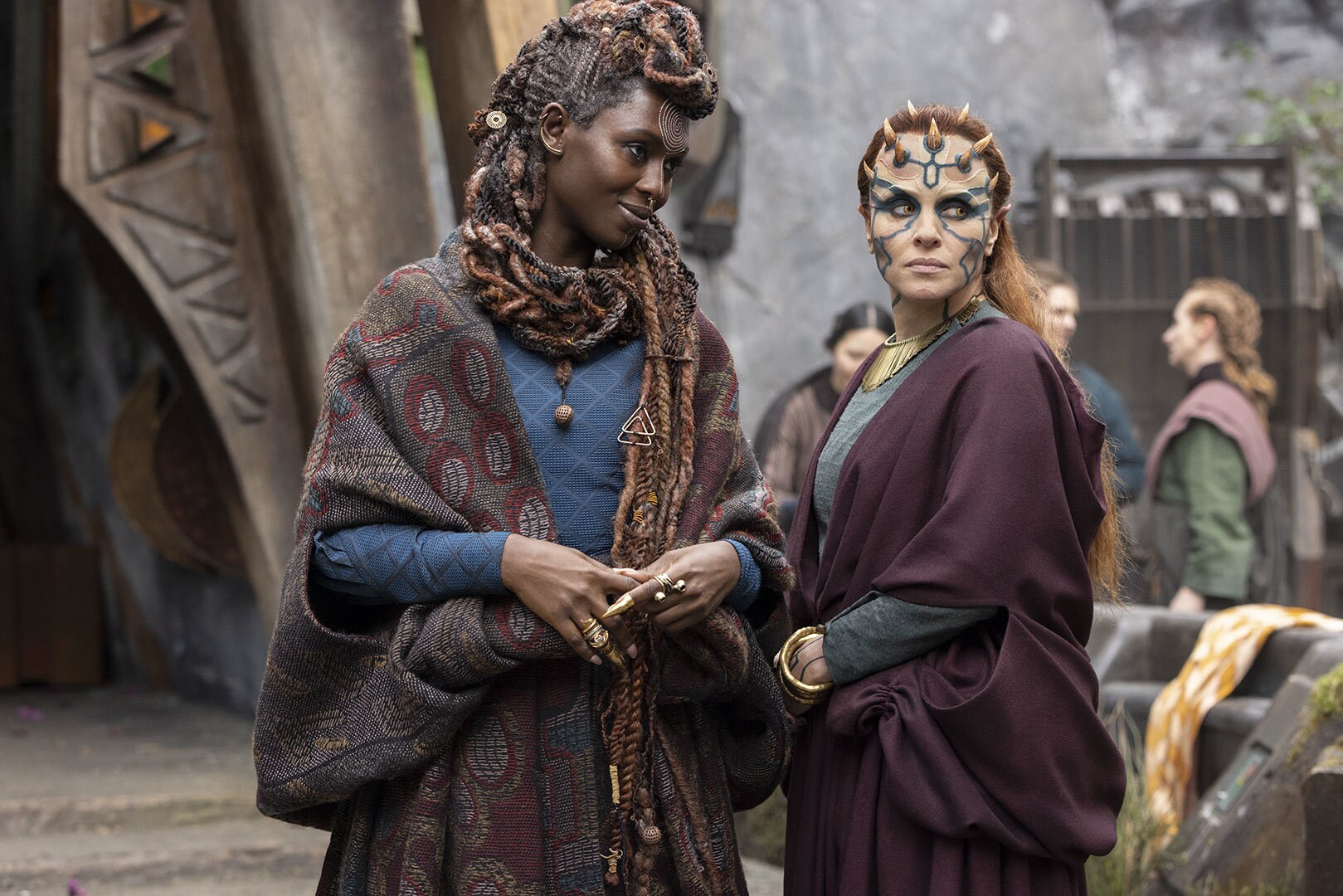
Jennifer Bryan: Yes, this is a whole new community and population on a planet we haven’t seen before. The Jedi stumble upon it, not knowing it was inhabited. It’s a community solely of women. Within this community, you’ll see humans and aliens that you’ve seen before in Star Wars. That was both cool and challenging because you have to design the same look for regular human forms and then adapt it for aliens with different head shapes or horns and think about how to keep the hood on.

In the beginning, I had to figure out the population diversity of the witches, and they are very diverse. I had so much fun with this, and Jodie Turner-Smith was an absolute delight to work with.
Here you can see the royal purple in the Ascension robes. Each robe was slightly different but not drastically so. Hers, because she is the mother and queen, has hand-beaded little cowrie shells and sequins. In her hair, we incorporated metal bits, reminiscent of the Metal Age, with beads here and there. She has a beautiful copper cuff that goes from wrist to almost the elbow. It’s inspired by an ancient copper arm bracelet I found in London. We reproduced it in hard rubber to make it comfortable for her to wear. The neck piece, a high gold collar, accentuates Jodie’s tall and graceful neck.

Spencer Williams: Just a casual daytime, Met Gala look.
Jennifer Bryan: Exactly! In another image, you see her day cloak, which is casual royalty with a Met Gala flair. We introduced patterns and prints, which are less common in Star Wars costumes that tend to be solid colors. I was fortunate to visit Skywalker Ranch and see Trisha Biggar’s original costumes from other previous Star Wars films. That inspired me a lot. Here, I used those influences and brought in elements from African and old continental designs, which are most evident in this community of women.
Spencer Williams: I was totally astounded by all the textiles. I hope we see a museum for The Acolyte costumes, even if it’s just for the witches’ costumes.
Jennifer Bryan: That would be fabulous. I’ll tell you a little story about when I sourced some fabrics. Sometimes I’ll see a fabric or material and just be drawn to it. My assistant would ask, “What are you going to use it for?” and I’d say, “I don’t know right now, but I have to have it.” For her day robe, I found this fabric in London. They have great fabric stores there. I saw this woolen piece with graphics and bought it without knowing if I’d ever use it.

When it came time to design and Jodie was cast, I thought, “That fabric I got,” and we opened it up. But my cutter said, “You don’t have enough to do what you want.” I was so disappointed. I had bought it months before shooting and hoarded it for this moment, only to discover I didn’t have enough. So we went on a search to find more. It was stressful, but one of my buyers found it. Another buyer from another show had seen it on a shelf in a shop. My buyer ran over and found it as a remnant. We snatched it up, brought it back, and made the cloak.
Even though it was wool, we overdyed and distressed it to mute the pattern because it was a bit bright in its natural state. That’s how we made the cloak work.
Spencer Williams: Another one of your Jedi tricks. I’m so thankful you found the fabric. It’s fantastic and one of my favorite costumes from the series so far, and we’re only three episodes in.
Speaking of proportions, we see the Wookiee Jedi, Kelnacca, walk up in his lovely Jedi robes. How do you fit a Wookiee?

Jennifer Bryan: That was a challenge. I had to deal with the actor, Joonas Suotamo, who plays the Wookiee Kelnacca. Joonas is about 6’8″.
Spencer Williams: That’s like two Spencers.
Jennifer Bryan: Yes, and three Jennifers. So I had to consider his height and the Wookiee costume. Sometimes, during fittings, I had to stand on a step stool to make sure everything fit properly. My tailor, Thomas Traxler, who is also tall, was very helpful.
First, we fitted him without the head to ensure the robes were laid properly. Then we added the head, which has animatronics for facial features. It was a lot of collaboration, but I think he looks great. He looks good without clothes, but also great with clothes on.

Spencer Williams: I love that he’s wearing clothes, and I love the mental picture of you on a step stool fitting a Wookiee. I’m sad to say we’re at the end of our conversation because we’ve only seen the first three episodes so far. I hope we can talk again in a couple of weeks.
Jennifer Bryan: That would be nice. You can come back after Episode 4 or 5, and we can chat more because there’s a lot more to come.
Spencer Williams: I’m very excited and eager to see what’s ahead. Now that The Acolyte is out in the world, what has it meant to you to see the audience’s response?

Jennifer Bryan: I’m over the moon. Thrilled beyond words. Design-wise, it’s tremendously satisfying. I appreciate that people are paying attention to the clothing as much as the story because the costumes are part of the storytelling. When you’re creating something imaginative and starting from the ground up, it’s very fulfilling.
Spencer Williams: You and your crew should be very proud. It’s a great show, and I’m loving every single costume. Thank you so much for joining us, Jennifer Bryan. This has been such a joy. I hope we can talk again soon.
Jennifer Bryan: Spencer. It’s been my privilege. Thank you very much. I can’t wait!

