
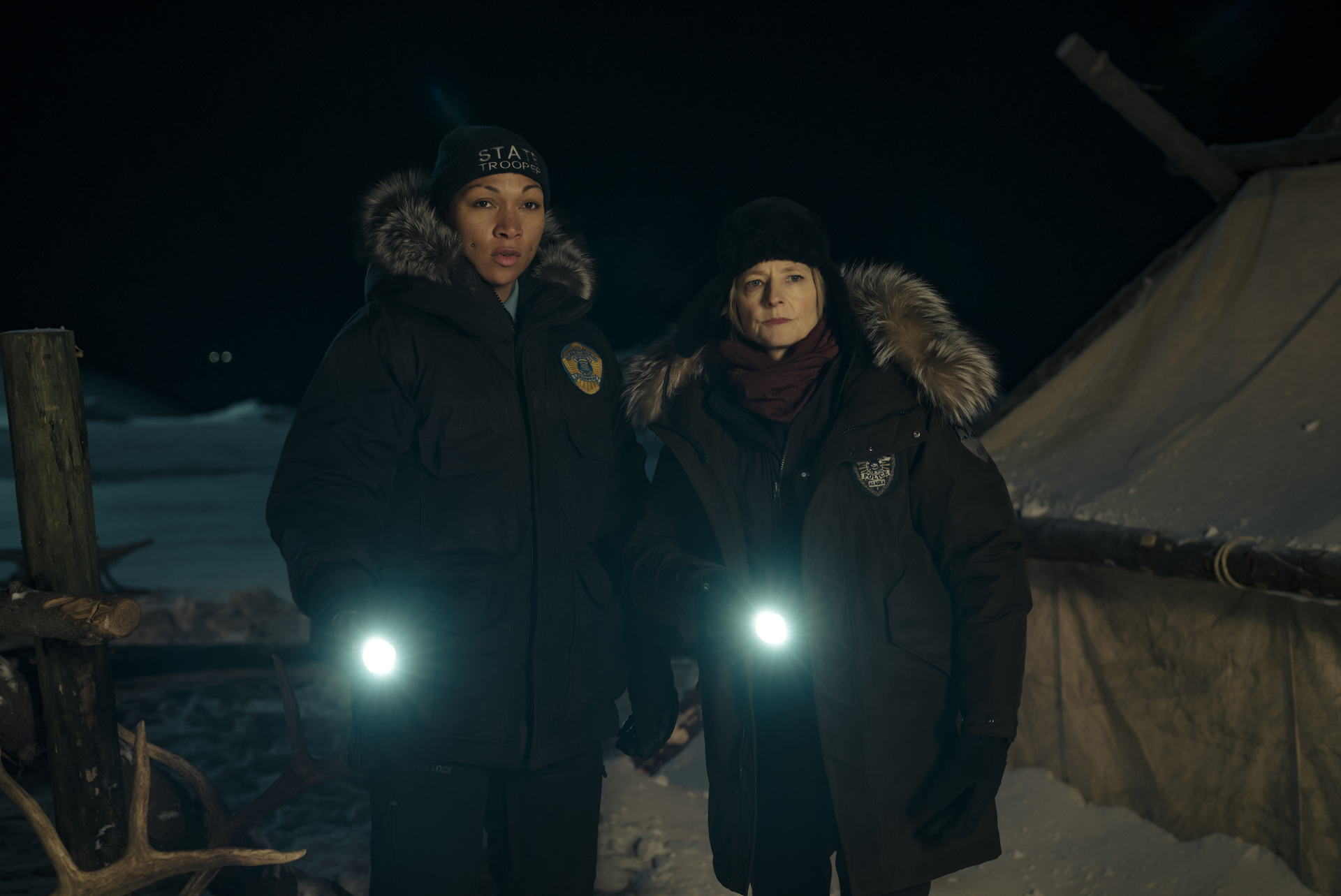

Grab your flashlights and large coats because it is about to get dark and cold. In this conversation, we dive into costume design with Alex Bovaird, the visionary behind the striking costumes of True Detective: Night Country. Join us as Alex shares the intricacies of designing for a show set in the perpetual darkness of Alaska, revealing how she balanced realism with artistic flair. Discover the behind-the-scenes process of collaborating with Jodie Foster, the challenges of integrating light and darkness into costumes, and the thoughtful approach to representing indigenous cultures.
Spencer Williams: I am so excited to welcome my friend Alex Bovaird back to The Art of Costume.
Alex Bovaird: Hey! It’s great to see you. You look exactly the same, with the microphone in front of you and headphones on.
Spencer Williams: You’re so funny. Whenever I talk to you, you’re in a different state or country or on another planet. So, where are you this time?
Alex Bovaird: I’m in Bangkok at the moment, just finishing up on The White Lotus season three, and headed to London very soon. I was shooting True Detective: Night Country the last time we talked.

Spencer Williams: Yeah, you were in Iceland, and you were, rightfully so, kind of vague on the details. You said, “Oh, it’s a detective-type show,” I was like, “All right, that sounds fun.” You’ve now been nominated for three Emmys since then. I mean, how has it been over these past two years?
Alex Bovaird: Amazing. We’ve had a great time traveling the globe, working for these different HBO shows. I worked in England over the summer on a couple of films and it’s been great. The True Detective: Night Country job seems like an age away now, so hopefully, I’ll have something fresh to say.
Spencer Williams: Well let’s get into it. As you mentioned, you were in Iceland the first time you and I talked. The show takes place in Alaska, but it was filmed in Iceland. That must’ve been quite a journey for you. How did the Icelandic environment influence your costume design process? I imagine it was a wee bit cold, perhaps a little dark sometimes. Just take me back. What was that experience like?
Alex Bovaird: We headed to Iceland because it is the land of ice and snow, and they have a lot of darkness during winter. The whole of True Detective: Night Country takes place during polar night when the sun doesn’t come up for thirty days. So, we needed a lot of darkness. There were a lot of night shoots. During the Winter, you only get three hours of daylight.

The shopping there was helpful, but our whole show takes place in Alaska. So, to replicate the look, we actually went to Alaska for a month. We did a lot of shopping there, did a lot of research, and met with many Inupiaq experts who taught us some of the techniques they use to make their garments. We also brought over an entire Value Village and put it in our office so we had lots of good, worn-in, thrifted Americana to pull from.
Spencer Williams: You have to be very focused on your resources. I imagine there aren’t a lot of H&Ms and Zaras in Iceland where you can shop.
Alex Bovaird: H&M was the one store they had. We hauled lots of stuff from Walmart because they had more middle-class, chic European clothing but not much hard-wearing clothing like Carhartt and camo. We needed classic American sweatshirts and just little details that you look for when you’re doing a show like True Detective: Night Country. So, we went to Alaska for a while and gathered as much as possible to take over.
Spencer Williams: Returning to the beginnings, how did you collaborate with showrunner Issa López to bring the Alaskan setting to life through the costumes? What key elements did you focus on to ensure authenticity to Alaska, which, as portrayed in the show, is a very remote and rugged environment?

Alex Bovaird: One thing we discussed in our first meeting was how remote this community is. In real life, people hold on to things for a long time and hoard objects and clothing, so they have an eclectic, bright, and varied wardrobe. It was important to incorporate the correct bits and pieces for the Inupiaq culture, which I knew absolutely nothing about before I did this job. They live in what is called a village, which is a protected area. Their clothing is a mixture of native Alaskan traditional garments and Western wear. They might wear Carhartt overalls, but they might have their traditional parka over it, which is something they make in the village. They hand-sew and use furs like Wolverine and Arctic Fox with big ruffs. They might wear combat boots, Caribou chaps over their jeans, a big oilskin coat, and a fur hat. There are some amazing combinations of native and Western cultures. That was fascinating, with layers of clothing and things I’d never seen before.
The clothing is very practical, and you can see how the ice and snow interact with it, with little icicles forming on the fur ruffs. In winter, they have to cover themselves from top to toe. The Inupiaqs and Western Americans wear gloves, snoods, hats, and ski pants. We watched a lot of a show called Alaskan State Troopers. It’s like Cops, but set in Alaska.

Spencer Williams: I’ve seen an episode or two.
Alex Bovaird: That was compelling viewing. We watched a lot of that, and you see how they hop onto snowmobiles and go out to these remote villages to deal with crime. It’s pretty extreme out there.
Spencer Williams: It’s challenging to wrap your head around, too. You and I have probably discussed this before, but contemporary costume design can be challenging. You’re telling a story through the clothes. This show has a lot of layers and putting coats on top of each other. To put your mindset in the minds of these people who are just living everyday life and getting in tune with what it means to survive out here is fascinating.
Alex Bovaird: Jodie wanted to include all these details. Like, every time you come in, you take your boots off. It’s a practical part of life—they need to disrobe as soon as they get in. So that’s quite a lot in the show, where they hang up coats and hats and take off their boots.
Spencer Williams: I think she even says at one point, “Take off your boots.”

Alex Bovaird: In real life, they do that constantly. We show it quite a lot in the series, but not every single time. Otherwise, you’d see an awful lot of boot removal. They live in small, cramped spaces, and as soon as you get in, you’re quite warm. We always had to decide if they would take their coats off or keep them on. The coats were custom-made for them, so once you put on those bulky parkas, there’s no looking skinny in those. But we were shooting in such extreme cold that everyone was happy to stay bundled up and keep their hats on.
Spencer Williams: Probably the most immersive costumes ever. You’re relying on this costume at this point.
Alex Bovaird: I remember doing boards for it and thinking the silhouette would be cool. They kind of look like looming animals with hunchbacks, and we wanted to make them look kind of badass in the snow. The fur was helpful for the lighting, too. The fur ruffs, which were lighter in color, caught the light beautifully.
Spencer Williams: I want to talk about the Ennis police uniform. When you think of police uniforms, there’s usually not a lot of creativity, but it’s such an integral part of Jodie Foster’s character, Liz Danvers. It’s central to who she is and establishes the series’ tone. Can you walk us through the design process and how you balanced practicality with this uniform and the atmospheric demands? You mentioned you were watching Alaska State Troopers. So that’s one place to start.

Alex Bovaird: Yeah, we watched a lot of that. I looked at other detective shows like Fargo, which is very comparable. We thought a lot about creating our unique uniform. But, as you said, there’s not much range regarding uniforms. Color-wise, you’re limited to brown or blue. We landed on a khaki olive color mixed with some browns. We developed our parka with a company called 66°North, which is custom-made for Jodie. It was based on something they already had, and once we had our parka, we fit the uniform around that. We looked at different furs and loved ones that caught the light beautifully and let snow fall on them.
We did a lot of real-life studies. I interviewed an Alaska State Trooper I met in Alaska and was always texting his wife to check the fabric content inside his pants. We had to replicate the troopers’ uniforms because you can’t just get them from the troopers. It was quite a challenge, especially with COVID-19 supply chain problems. It was one of those jobs I thought would be easy because it was a uniform show, but getting the uniforms right was an exhaustive process. We found a woman in Colorado who makes bulletproof vests for the troopers. She made our custom vests, and it was a matter of piecing them together from New York, Alaska, Colorado, and Poland, getting different materials.

Spencer Williams: We have to talk about Jodie Foster. I mean, she’s an icon. What was it like working with Jodie Foster, and how did you approach the collaboration and design of costumes for her character, Liz Danvers? She’s a very layered character with many things she’s going through that you explore throughout the series.
Alex Bovaird: Yeah, she’s amazing. When I met her, I found her to be incredibly easygoing and down-to-earth. Despite her iconic status, she doesn’t carry the usual entourage or the airs of a huge star. She doesn’t have an assistant. I called her directly, and she said, “Do you want to come over to my house?” So, we had tea, and I showed her my boards. We discussed her knowledge of policewomen and her ideas for Liz’s costumes. She thought it was nice to incorporate some feminine touches. Her idea was to include pink and other soft, almost girly elements juxtaposed with the tough, straight-talking Liz Danvers we see at the police station. She noticed that women in police work often embrace their femininity when off duty. That’s why Liz wears a pink North Face fleece and has an unexpectedly lacy bra when she visits Connelly, adding layers to her character.

She’s very petite, so we custom-made her shirts with smaller pockets and details to fit her proportions. Otherwise, off-the-rack clothes would make her look like she’s dressing in adult-sized clothing. Jodie is a wonderful collaborator. She gives you the space to create and simply offers her thoughts. On set, she likes her clothes placed in her trailer and trusts you to choose what she’ll wear based on fittings. Being a director herself, she always had lots of questions about the scenes, ensuring she fully understood her character’s actions and motivations. Her attention to detail and thoughtful nature kept everyone on their toes. She was a joy to work with, setting a positive tone for the entire crew, and she’s one of the coolest people I’ve had the pleasure of working with.
Spencer Williams: Her thoroughness shows through, much like her character. But there’s such a contrast with Evangeline Navarro, Liz’s partner in the series. Navarro brings a different energy, and it is more like she’s ready to face whatever challenges come her way. She almost has this armor-like presence. Was that the intention with her costumes?
Alex Bovaird: Navarro is tough and defensive, existing in a male-dominated world. She uses coarse language and asserts herself strongly. What drew me to the project was the relationship between Danvers and Navarro. I love those characters. Navarro’s character is slightly more untamed, and working with her was exciting. Kali Reis, who plays Navarro, is a different kind of actress from Jodie. She’s fresh and new and came into this as her first major acting role. She had raw energy and was very open to guidance. Together, they had strong chemistry.
Navarro’s trooper uniform is similar yet distinct from Liz’s, so we worked to make them look like a cohesive pair.

Spencer Williams: And now Kali’s an Emmy nominee, which is incredible.
Alex Bovaird: She’s amazing. I loved working with her.
Spencer Williams: I’m so happy for her. I noticed that light played such a significant role in True Detective: Night Country. It was almost like its own character, with scenes illuminated by flashlights or headlamps. How did lighting influence your choice of materials, colors, and textures? Did you have to adapt the costumes for this type of lighting?

Alex Bovaird: Yes, absolutely. We did a lot of tests with Florian Hoffmeister, the cinematographer, and experimented with materials to reflect the light and avoid overly matte finishes. While police uniforms have to be dark and practical, we used a lighter shirt for Jodie. For her civilian parka, we chose a milky white, which initially surprised Florian since directors of photography often avoid white. But it worked beautifully, allowing her to stand out like a ghostly figure. In the darkness, light or bright costumes help identify characters. The fur elements also caught the light wonderfully. At times, it was so dark you could barely see more than their faces, but that was a deliberate choice, adding to the atmosphere.
Spencer Williams: You’ve touched on this before, but I’m curious about aging and dying costumes. Given the icicles, snow, and wear, did you have to work hard to achieve the worn effect, or was the natural environment enough?
Alex Bovaird: It was a bit of both, you know. Sometimes we were in a studio, so it wasn’t cold, and we had to add powders and fake snow. You want to do as much as possible, but sometimes it doesn’t look realistic. In real life, you’d come in, and it would look wet. But because we were in a studio, you had to choose between putting a few drops on or using fake snow, which doesn’t disintegrate. It was a lot of learning as we went. Sometimes the snow would just stick around for a few minutes, and other times, the characters would come in from a blizzard, and there’d barely be anything there.

When we were in real conditions, their faces would get red, you could see their breath in the cold, and we shot in a few blizzards where icicles would form on fur and everything. We couldn’t achieve the full effect due to the nature of filming, so I was excited when I saw the real thing but was never quite able to replicate it as well as I would have liked. We had a full-time aging dyer and learned how to do snow effects. It was a huge part of what we did, breaking everything down.
These days, fabrics are made of technical materials that are almost indestructible. The police uniform went through a lot, but they’d still spring back to the same shape. There’s not much you can do, but that’s how they look in real life, so it’s true and authentic.
Spencer Williams: That’s so funny. It couldn’t be a more different project than The White Lotus. When you did True Detective: Night Country, was it after season two of White Lotus or after season one?
Alex Bovaird: We actually flew—my husband and I worked together in the costume department—from Sicily to Reykjavik and started True Detective: Night Country. They’re completely different.
Spencer Williams: From mopeds through Italy to painting snow on costumes.
Alex Bovaird: Yeah, like flip-flops and bikinis to parkas, fur hats, gloves, and ski pants. Working in those conditions was varied, and you had to figure out your kit for the day. Getting the right boots for True Detective: Night Country took me a while.
Spencer Williams: No one really talks about how your crew has to adapt to that sort of environment.
Alex Bovaird: My crew—anyone in the costume department knows how hard set costumers work, but on a project like True Detective: Night Country, they’re the real heroes. They’re outside all night with the actors, ensuring continuity and comfort. It’s brutal. I could go back and forth to the trailer, but they were outside for twelve hours. Hats off to Andre and Lexi and the others who looked after the actors. They were incredible.

Spencer Williams: That’s a huge shout-out. The portrayal of indigenous communities in this series played an important role. How did you approach designing costumes that respectfully and accurately represented these communities while fitting the show’s narrative? What did your research look like?
Alex Bovaird: We did a lot of internet research, looked at books, and found a great photographer named Brian Adams who shoots in the Arctic Circle. You learn about villages like Kotzebue and find native Alaskan Facebook groups, which offer incredible research. They’re a strong community that gets together for meals and celebrates when they catch a whale. Their whole community is based on hunting and keeping traditions alive.
In Alaska, we met with people from the Anchorage Heritage Center, who showed us the history of garments. They still have their version of what we think of as an Eskimo parka. They have garments called kuspuks and attikluks, which are vests made of canvas to get dirty while hunting and then cleaned. They go over big puffy parkas, and young girls still wear them. They’re vivid and colorful, with forget-me-nots and salmon berries. We bought fabric from Alaska, and a young girl named Danielle showed me how they make parkas and trims. We brought that knowledge back to Iceland and replicated some of it.

It was a fascinating part of the job. There are scenes at a nomad camp and a village, and those were fun to play with different textures, furs, and boots. The show features fishermen, and we did a lot of aging to show different levels of wear. They favor Wolverine for keeping the frost away. It was a costume element I didn’t know was part of the show until I started digging in.
Spencer Williams: It’s one of my favorite parts of the show, especially the nomad camp scenes. You get to see the details you and your team thought so clearly about. Before I let you go, we touched on this a bit already but looking back on the past couple of years, now you’re an Emmy nominee again for your work on True Detective: Night Country; what does this nomination mean to you and your team?
Alex Bovaird: We’re really excited and proud of it. We worked very hard. Working abroad brings a special element; finding what you’re looking for is fun but also extra challenging. So, to be rewarded and acknowledged by our peers is gratifying because everyone worked so hard to ensure it was as authentic as possible. I’m really happy, especially for my assistants, and we’re all going to LA to attend the Emmys. Working for HBO is a real privilege because they’re supportive of the heads of departments, so we’re lucky to be partnered with them.
Spencer Williams: You all should be super proud. It’s such a beautiful show, and I’m so excited for you. Every few months, I wonder, “What is Alex up to now?” It’s always something new and incredible. I can’t wait to talk with you again soon because we’re heading back to The White Lotus next.
Alex Bovaird: Let’s do it. Let’s check in.
Spencer Williams: Costume designer Alex Bovaird, thank you so much for joining us. It’s been a real joy.
Alex Bovaird: Oh, my pleasure. Thanks, Spencer.

