
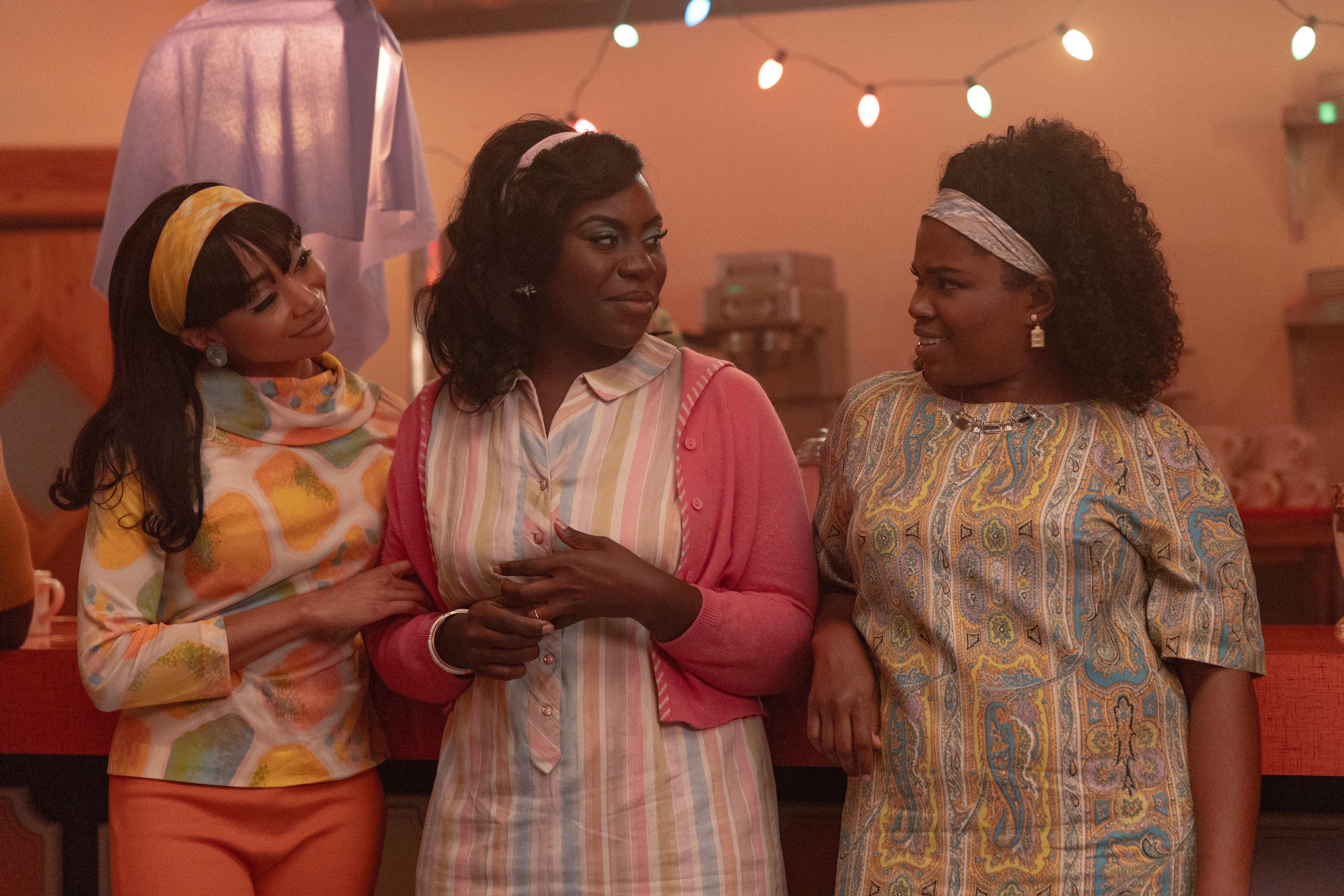

In this captivating interview, Whitney Anne Adams, costume designer for the heartfelt film The Supremes at Earl’s All-You-Can-Eat, takes us behind the seams of her creative process designing the costumes. Whitney discusses her work designing for the three Supremes—Odette, Clarice, and Barbara Jean—crafting costumes that reflect their personalities and deep bond. From Miss Minnie’s dazzling zodiac-inspired costume to the challenge of designing over 1,000 period costumes, Whitney shares how she brought the beloved characters and their world to life, reflecting on the joy and growth that came with her first major period film.
Spencer Williams: I am so excited to welcome back to The Art of Costume, my dear, dear, dear friend, costume designer Whitney Anne Adams. Whitney, so good to see you.
Whitney Anne Adams: Hi! So good to see you too. I’m so happy to be back.
Spencer Williams: I’m excited to discuss The Supremes at Earl’s All-You-Can-Eat costumes. I remember when you were away working on this project, telling me. I’m so excited to talk about it finally.
Whitney Anne Adams: I’m so glad it’s finally out and people can see it.

Spencer Williams: And loving it, by the way—which I did. You’ve worked on an incredible range of films, from The Great Gatsby to horror. How did your background in horror and all these genres influence your approach to this deeply emotional, character-driven film like The Supremes at Earl’s All-You-Can-Eat?
Whitney Anne Adams: What’s so cool about being a costume designer is that my process stays the same, no matter the script or genre. It starts with reading the script multiple times, breaking down all the visual references, figuring out who these characters are, and then diving into research.
For this film, there was a lot of research because it takes place across four decades—1950, 1968, 1977, and 1999. So, I had to do a ton of research in a very short amount of time. That’s what I love about costume design: I get to immerse myself in all these different times and places. I focus on the research, whether it’s contemporary horror or a period piece like this.
Spencer Williams: This film is adapted from The Supremes at Earl’s All-You-Can-Eat by Edward Kelsey Moore. Knowing you as well as I do, you probably read the book a thousand times.
Whitney Anne Adams: Yes, absolutely. I even reused the visual spreadsheet I created for The Great Gatsby. I read that book about 40 times when I worked on the film, and I adapted the same spreadsheet for this project. I pulled every visual reference from the novel and the script so I had a solid foundation to work with.
Spencer Williams: You approach things like a scientist-slash-historian.
Whitney Anne Adams: I love paperwork.
Spencer Williams: That’s true! So, as a costume designer, how do you balance historical accuracy with creative freedom on a project like The Supremes at Earl’s All-You-Can-Eat? The costumes don’t overshadow the story, but there’s definitely a Whitney Anne Adams flair in there—if I’m being honest.

Whitney Anne Adams: Oh, thank you! I do love my textures, patterns, and colors. Historical accuracy is so important, especially if that’s the project’s goal, but perfect accuracy isn’t always possible. There are many logistics to consider: the order of filming, the actors’ sizes, the locations, and even safety concerns, like closed-toe versus open-toe shoes for stunts.
For example, when Odette’s mom gave birth to her in the tree, we needed a stunt double for that scene. I couldn’t find 1950s pregnancy outfits in multiples for both women, so we had to build those dresses. Balancing historical accuracy with what’s feasible is always part of the design process.
Spencer Williams: There’s a lot to think about. As you mentioned, the story spans multiple decades, from the 60s to the 90s—a big chunk of time. How did you create a cohesive sense of evolution for these characters that I’m now obsessed with—Odette, Barbara Jean, and Clarice? I love them! I read that you started with the adult characters first. That seems like such a tricky approach to wrap your mind around.
Whitney Anne Adams: I really jumped back and forth, but I started with our adult cast because they were the first three actors confirmed. I wanted to establish their looks, knowing we’d be filming the younger versions first. Even though the timeline felt backward, I needed a clear vision of where we were heading with the characters. That meant ensuring the colors, patterns, and silhouettes I chose for their younger selves would naturally evolve into what we’d see with the adult cast.

I went online and gathered as many photos of Sanaa, Aunjanue, and Uzo as I could, studying which colors and patterns complemented them and felt true to their characters. From there, I worked backward once the younger actors were cast. Using the adult palette as a foundation, I figured out what worked for the younger cast and started narrowing down options—what could be sourced, what needed to be built, and how it all fits together.
Spencer Williams: This isn’t even a question, but I have to say—Aunjanue Ellis is one of the greatest actresses of our time. They’re all amazing, but I could watch her do absolutely anything. She’s phenomenal in this film.
Whitney Anne Adams: She’s truly incredible. I loved collaborating with her and creating those specific looks for her character. The outfits we designed felt so right for the character, both in the novel and the script, and Aunjanue brought so much to them. Our fittings were amazing—we felt the vibe, and the costumes clicked into place.
Spencer Williams: I’m excited to dive into her looks in a bit, but let’s talk about color in the The Supremes at Earl’s All-You-Can-Eat costumes. I loved how the younger characters had these brighter palettes with playful textiles—lots of pastels and fruit-inspired looks. Then, as the story moves into their adult lives, the tones deepen into richer jewel tones, reflecting maturity. But you can still feel the echoes of their younger selves in the costumes. It’s such a beautiful evolution. How did you use color to inform the audience about these characters’ journeys?
Whitney Anne Adams: I think you nailed a lot of it. In 1968, I wanted to capture both the era and who these young women are—just turning 18, full of optimism, with their whole lives ahead of them. Their clothing reflects their youth and the vibrancy of the time.
One of my favorite scenes is the dance at Earl’s. It’s the moment when they’re the most in sync with each other—emotionally and visually—and at their brightest and happiest. Their costumes reflect that joy and harmony.

By the time we meet the older versions of these characters, life has shaped them. They’ve experienced the highs and lows that come with age, and their costumes reflect that maturity. The colors deepen and become more elegant, representing how they’ve settled into themselves. There’s a beauty in their evolution—it’s more subdued, but it’s powerful.
Spencer Williams: It’s such a thoughtful progression. Now, you and I have talked a lot about collaboration. You’re such a natural collaborator—whether it’s with directors, production designers, or cinematographers. Can you share what working with the team on this film was like especially your director, Tina Mabry? It seems like you two had an amazing partnership.
Whitney Anne Adams: I adore Tina. She’s an incredibly kind, warm, and smart director—and just a wonderful human being. She created such a welcoming atmosphere on set. She also brought together an amazing team, including Kara Lindstrom, our production designer, and Sean McElwee, our DP. We were constantly in conversation, which was key.

Every week, I created a detailed PDF packet that included every costume in the film, whether it had been fitted, what I was envisioning, and fitting photos for each scene. It’s essentially a visual map of the film’s costumes—like downloading my brain for the team.
One example of how collaboration shaped the film is the dress Clarice wears during her piano recital. Initially, I loved the idea of her in a black dress, and she did too. But Kara pointed out that the stage curtains and set pieces in that scene were also black. I realized it would blend into the background. So, we pivoted to a beautiful, shiny silk satin dress. It ended up being perfect—it allowed Clarice to stand out as the radiant centerpiece of the scene, matching her character’s moment.

Spencer Williams: I cannot imagine it going any other way. It really was such a beautiful scene, and it speaks so well about the collaboration between all of you.
We had to talk about a specific costume I was dying to ask about. It’s called “the ugliest dress in the world” by one of the characters, as well as “virginity insurance.” I need to start using that line for almost everything I do! What was it like searching for the perfect fabric for this moment? And how did you ensure the dress reflected Odette’s personality?

Whitney Anne Adams: Oh, this is my favorite costume in the whole film because it genuinely encapsulates who Odette is. For me, it was the key to unlocking her entire lineup of costumes—both the younger and adult versions. The question became: what is the ugliest dress in the world? What does that mean, especially from Clarice, who says it to Odette?
On top of that, the dress was made by Odette’s blind grandmother, which adds another layer. It was crafted with love. I wanted it to represent Odette’s fiery personality, so I leaned into late ’60s vintage fabrics. I knew Odette’s costumes would be rooted in earthy tones—rusts and other natural hues—because they reflect her role as the foundational friend, the “rock” of the group.
But this dress had to show her fire right from the beginning. I searched vintage shops, Etsy, and eBay, combing through late ’60s fabrics. Finally, I found this fiery orange fabric with a wild, intricate pattern. It was so unusual—I haven’t seen many fabrics like it. As soon as I spotted it, I knew: This is it.
Spencer Williams: Were those lines—“the ugliest dress in the world” and “virginity insurance”—in the script?
Whitney Anne Adams: Yes, those lines are in both the book and the script. They became my guiding light for Odette’s character. I thought, Whatever this dress is, it has to embody who she is. Odette doesn’t care about aesthetics or trends. She wears things made with love, reflecting her values and deep connection to family and friends.
Spencer Williams: That’s so fun. I can imagine you reading that in the script and immediately having your brain fire on all cylinders.
Whitney Anne Adams: Oh, absolutely. I was obsessed with figuring it out—it was the ultimate puzzle.
Spencer Williams: Speaking of fun, I have to bring up Miss Minnie’s performance look during the portrait unveiling of Earl. You’ve got to tell me about that outfit! It felt Zodiac-inspired and was just so much fun.

Whitney Anne Adams: I’m obsessed with that dress! In the book and the script, Miss Minnie is described as an amateur fortune teller—though she’s not particularly good at it. Everything she wears throughout the film is zodiac-inspired. Most of her costumes feature stars, suns, moons, and zodiac motifs.
Even her funeral outfit has black beaded moons on a black dress. For the portrait unveiling, I wanted the perfect show-stopping piece. I dove into Etsy, searching for vintage zodiac designs. Luckily, I already have a passion for collecting vintage novelty pieces, so I knew exactly what to look for.
I found the dress in a vintage shop owned by someone who had kept it in their closet for 20 years. They didn’t remember where it came from, but they had listed it for sale just a week before I searched. It was serendipity. I bought it immediately. When Donna Visco, who plays Minnie, tried it on, it was a perfect fit—no alterations needed. It was like the universe aligned.
Spencer Williams: It’s like it was in the cards.
Whitney Anne Adams: (Laughs) I love a good pun.
Spencer Williams: That one wasn’t even planned!
Whitney, I really loved this film. It was such a joy to watch. You and I have talked about this before, but these have been challenging times in the industry—an understatement, really. Despite that, you’ve accomplished incredible things. From your podcast and column, Tales from a Costume Designer, to fighting and winning pay equity for costume designers, and now finally sharing this film with the world, you’re truly inspiring. What has this project meant to you?

Whitney Anne Adams: Thank you, Spencer. This film has been so meaningful to me. I love designing for horror films—it’s one of my favorite genres. But this project allowed me to explore another side of myself.
Working on The Great Gatsby made me fall in love with period films, and I’ve been eager to take on more projects like that ever since. Designing my first major period film was both exciting and terrifying. We created 162 principal costumes and over 1,000 background outfits—it was a massive undertaking.
That kind of challenge is scary, but I think fear can push us to become the best versions of ourselves. This project pushed me to grow in so many ways, and I’m incredibly proud of the result.
Spencer Williams: I am endlessly happy for you and proud of everything you’ve achieved. Costume designer Whitney Anne Adams, thank you so much for talking with me. It’s always such a pleasure.
Whitney Anne Adams: Thank you so much, Spencer.

