
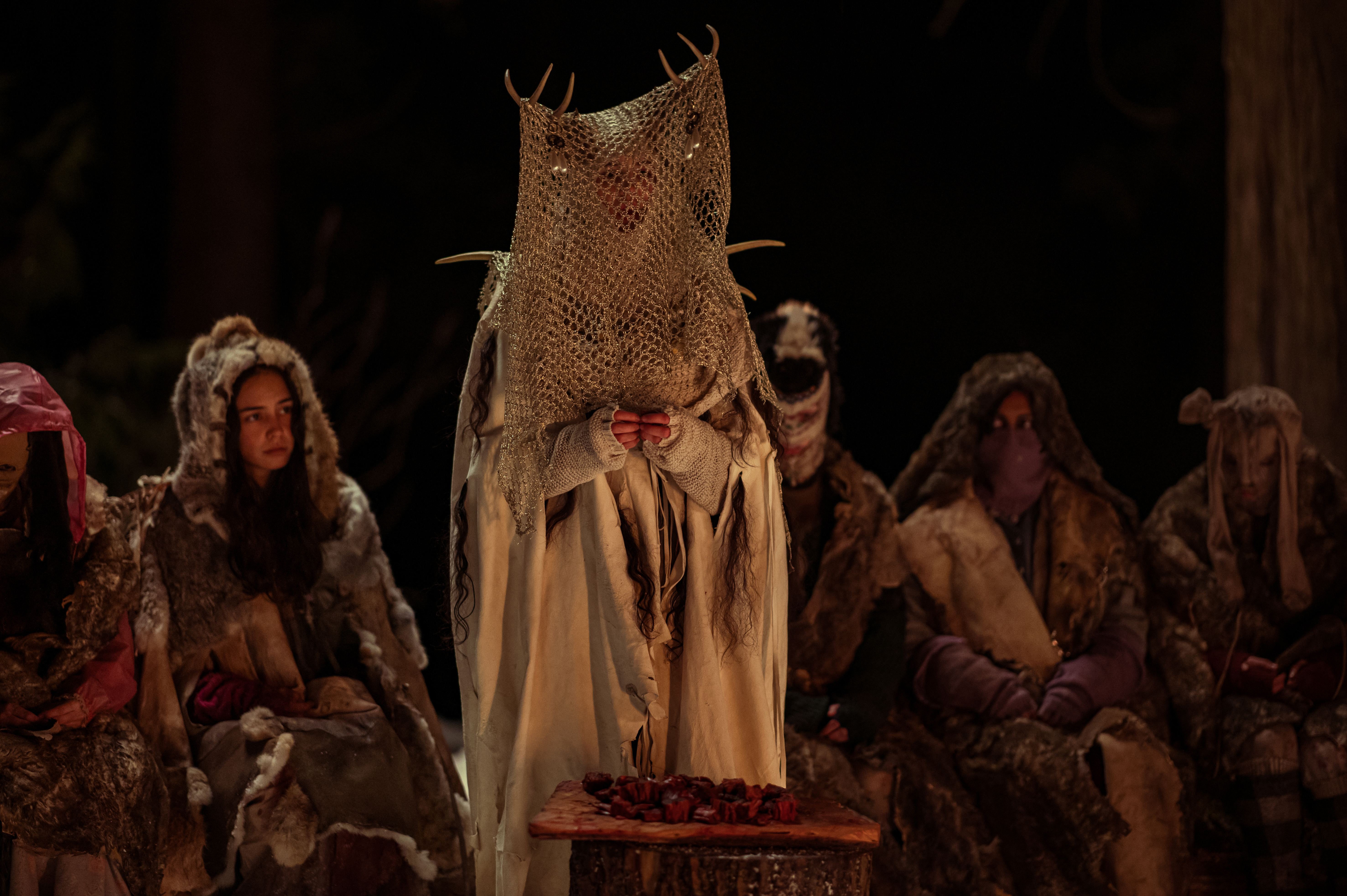

From rabbit pelts and burnt sweaters to suburban softball hats hiding dark secrets, Marie Schley’s work on Yellowjackets Season 3 pushes the boundaries of survival fashion with terrifying precision. In this exclusive conversation, the Emmy-winning costume designer takes us deep into the ritualistic details of the Antler Queen’s cloak, the evolution of Coach Ben’s horrifying descent, and how layers of trauma are stitched into every look—from Misty’s falsely perky nursewear to Shauna’s hauntingly relatable momcore. As the show’s present-day mysteries collide with its brutal past, Schley reveals how storytelling, symbolism, and a touch of ‘90s grit guide every thread in the wilderness and beyond.
Spencer Williams: I’m so happy to be here with my friend and the brilliant costume designer behind Yellowjackets, Marie Schley. Let’s talk Yellowjackets! This season picks up after a brutal winter, and to me, it kind of mirrors your return to the series. You designed the original pilot, came back toward the end of Season 1—and now you’re back again. So what was it like coming back into the world of Yellowjackets, after a little time away?
Marie Schley: It actually felt pretty seamless. I love the cast—they’re incredibly talented—and it felt like the right time to return. This season ties back to the pilot in a lot of meaningful ways, so it made sense for me to be involved again. What’s interesting is that I was designing in reverse—I already knew where some of the costumes ended up in the pilot, so I had to build a visual story that led us to those moments. It was really fun to rediscover some of the original design ideas through that lens.

Spencer Williams: I can’t wait to talk about the “Full Circle” episode later on, because I was truly trying to wrap my head around how you reverse-engineered all of that! But we’ll get to that. First, I’d love to know—when you first read the Yellowjackets pilot script, what was your reaction? What stood out to you?
Marie Schley: I was immediately drawn in. There’s always this layer of dark humor in the script, which I love. It’s disturbing, but it’s also smart and sometimes unexpectedly funny. And I was fascinated by the two timelines—the way the show explores past trauma through metaphor and survival. High school can feel like its own kind of wilderness, you know? So I really related to that.
Spencer Williams: High school is the wilderness.
Marie Schley: Exactly! And when I spoke with the pilot’s director Karyn Kusama and creators Bart Nickerson and Ashley Lyle, we talked a lot about that dynamic. In the pilot’s final ceremony scene, we came up with the idea of creating a visual hierarchy—kind of like a high school clique—with a queen bee at the top, and each girl having an animal symbol that represents her status in the group.
Spencer Williams: Right! That scene was absolutely terrifying—and so effective. So let’s jump into Season 3. When we return to the wilderness timeline, the girls have survived a brutal winter and now seem to have adapted to their environment. Their shelters are more refined, they’ve got animals—it feels like they’ve really started building something. Their clothing feels strategic, almost ritualistic. Tell us about your approach this season and where the girls are emotionally and visually.

Marie Schley: The first episode of Season 3 is meant to feel like an entirely new world. It’s the start of what we called “the season of the witch,” and we leaned into that. It’s also the summer solstice, as opposed to the fall or winter settings we explored in earlier seasons—so it gave us a chance to shift the visual tone.
We brought back elements from the pilot, like the white antler pelts—which are actually rabbit skins—and layered in new materials that reflect their growing resourcefulness. Margot and I made a list of what could realistically still be salvaged from the plane and the wilderness. One of the last unused materials was the vinyl from the airplane seats, so we repurposed it for waterproof hoods. It ended up looking really cool and practical, which was the goal.
Spencer Williams: One thing I’ve always loved so deeply about Yellowjackets is just how visceral the costumes feel. You can practically smell them. There’s the dirt, the blood, and just this intense level of breakdown that makes everything feel so real. Especially Coach Ben—I can’t stop staring at that costume.
How important was the aging, dyeing, and breakdown process to your work this season?
Marie Schley: It was huge. Honestly, it’s one of the most important parts of the Yellowjackets aesthetic—it’s what makes everything feel gritty and terrifying. Coach Ben was a major focus. We had to make him look like he’d lost a significant amount of weight—which the actor actually did—but we emphasized it by using oversized polo shirts to exaggerate his gauntness.

That final sequence, when he’s in captivity in the animal pen, was particularly challenging. We needed to hit very specific beats in terms of how deteriorated and foul he had become. He’s hiding food because he’s starving himself, so we had to ask questions like—where would he be hiding it? We worked with the director and landed on the idea that it was hidden under the stump he’s always leaning against.
Spencer Williams: That’s such a specific and effective detail.
Marie Schley: It was really fun to figure out. And I have to give a huge shout-out to our aging and dyeing team. They are just beautiful artists. They were meticulous—painstakingly matching multiple versions of the same costumes, progressing them through different stages of wear and distress. We’re not just talking about one set of clothing—there are multiples for stunts, for continuity, and for every stage of deterioration. I think we had at least three people working on that full-time.
Spencer Williams: I can only imagine. Especially with how physical the show is—there’s so much movement, so many stunts—of course you need multiples. Let’s jump forward in time a bit. First, I just have to say—I love this cast. It’s stacked: Melanie Lynskey, Tawny Cypress, Christina Ricci, Lauren Ambrose… and I love how you approach each of them and their characters.
Years have passed since the incident in the wilderness, and there’s a deep sense of trauma that binds all of them. Yet you and your team give each woman a unique visual identity. Can you talk a little about your collaboration with these incredible actors—who are so in tune with their characters—and how you helped them find those characters through costume?

Marie Schley: Absolutely. They have such incredible chemistry, and they know their characters so well. But the characters have evolved a lot over the seasons—as have we, as designers. Everyone, including the actors, is discovering new layers of their character as the story unfolds. In Season 1, we didn’t even know all the details of what happened in the wilderness yet.
What’s really become clear to me is that each woman is wearing a kind of mask. Whether it’s Shauna’s suburban-mom look or Misty’s overly cheerful, almost saccharine appearance—every outfit is hiding something more primal underneath. Christina Ricci, for example, has such a brilliant sense of Misty. In the first episode this season, Misty finds and puts on Natalie’s old motorcycle jacket. And Christina was adamant—and absolutely right—that Misty should keep wearing it throughout the season.
Spencer Williams: That detail was so good.

Marie Schley: Right? It was such a smart instinct. The idea is that Misty draws strength from Natalie’s jacket—maybe even a little of Natalie’s moral compass. It becomes like armor. And that kind of mirroring connects beautifully to what we see in the wilderness—how they share clothes there too. Like how Shauna wears her friend’s butterfly shirt.
Spencer Williams: Yes! That mirroring is something you’re so good at—there’s just this realism to it. The wilderness timeline is so extreme, so horrifying, filled with animal masks and ritual, but then when we return to the present—like with Shauna—there’s this very real suburban mom vibe. And that realism makes it easier to feel their trauma and connect with who they are now. I think the costumes do so much of that emotional heavy lifting.
Speaking of Shauna—I’d love to hear more about your collaboration with Melanie Lynskey. How has your work together evolved over the seasons?
Marie Schley: Melanie is just brilliant. She creates this incredibly terrifying character, but in such a quiet, grounded way. One thing I really love is how much thought she puts into Shauna’s music taste. She’ll always ask, “What band t-shirt would Shauna wear here?” In Season 1, it was a Yo La Tengo shirt. This season, she chose a feminist riot grrrl band from the ‘90s—I can’t remember which one off the top of my head, but it was perfect.

These band t-shirts become subtle clues into Shauna’s past. Melanie’s always thinking about who Shauna was before the wilderness, and how that shapes who she is now. She really understands that Shauna is trying to hold her family together by pretending to be the perfect mom—so that facade is really important to get right.
Spencer Williams: Right? I mean, I’m practically heavy breathing after each episode. I’m like—wait, what? I did not know that about Shauna! By the end of Season 3, she feels like an entirely different person.
Marie Schley: I know! When I read the script where she bites Melissa, I was like… what?!
Spencer Williams: I had to look away during that part.
Marie Schley: Same here.
Spencer Williams: Okay, let’s jump back to the wilderness for a moment. One of my favorite scenes this season was the trial of Coach Ben. The Yellowjackets create this makeshift courtroom using whatever they can find—but there’s clearly influence from courtroom TV. It felt like they’d been watching Judge Judy or Law & Order and recreated what they remembered, but with blankets, scraps, and wilderness debris. I’d love to know how you and your team approached designing that scene. How do you create a courtroom in the middle of nowhere?

Marie Schley: Some of it was in the script—like the white cape Natalie wears. That was actually the beginning of the Antler Queen silhouette. It’s our first visual hint. She even puts on antlers as part of her “judge” look.
And one thing the girls have plenty of after the fire? Blankets. So in early fittings, we started draping them in different ways. Liv draped one over her shoulder in this really striking way, and I remember thinking, Okay, that actually looks official. Like a uniform. They’re creating a real sense of ceremony.
They were clearly trying to designate roles in this courtroom they’ve imagined—robes, uniforms, visual hierarchy—like you’d see with a judge or a bailiff. It was fun to explore how they’d use materials like blankets, rabbit skins, airplane seat covers… whatever they had, to build that sense of ritual and structure.
Spencer Williams: It totally worked. I was like, “Yeah, let’s hold a trial. I’m into it!” It made complete sense within the world.
Let’s shift gears for a moment. Just when we think this cast can’t get any more stacked—boom, we find out Melissa survived the wilderness. And she’s played by Hilary Swank!What was it like working with Hilary on this guest role?

Marie Schley: She’s such a badass. I love how physical her role is—it’s something she’s so good at. We still don’t know a whole lot about adult Melissa, but we will learn more. What we focused on in this season was the big battle sequence. Hilary brings so much emotion to physical performance, and she was very clear about what she wanted her costume to be.
It’s essentially a workout outfit—Melissa is another character masking herself as a suburban mom. That’s why we gave her the backwards baseball cap. It’s a visual link to her younger self. We even made it a softball team cap, just to suggest she might coach her daughter’s team or something like that. It grounds her in the present, but still connects her to the wilderness era.
Spencer Williams: That kind of visual callback is exactly why I love storytelling through costume. When Shauna was hiding in the closet and Melissa walked in—you don’t know who it is at first—but she’s wearing the hat, and I gasped. I was like, It’s Melissa. You gave us the clue and I caught it! I loved that moment.
So, let’s talk about the full circle moment—literally. The final episode is titled Full Circle, and it loops us back to the winter scene from the pilot. And on top of that, we finally learn the identity of the Antler Queen—it’s Shauna. I should’ve seen that coming, but I didn’t.

Tell me about the process of putting together the costumes for this episode. Were you pulling things out of storage? Did you rebuild them? We got to see so much more detail this time—like, was that human hair in the Antler Queen’s costume? I feel like I saw things I thought were there before, but maybe I didn’t. Walk me through how you pulled it all off.
Marie Schley: Honestly? I don’t think anyone knew it was going to be Shauna. When we were filming the pilot, I was convinced it was going to be Lottie.
It was really fun to go back to that world. In the costume department, we had already created a lot of internal backstory around those ceremonial looks. So we had a foundation to build from—but the Antler Queen’s costume was never originally made to be dissected. We had to go back and rework it so that it could be worn ritualistically, and so we could show the evolution of the costume.
I came up with the hair element back in the pilot—it was meant to be human hair on the Antler Queen’s cape, symbolizing her status at the top of the hierarchy. She was the apex. But back then, we didn’t have to figure out how to put that hair on during a scene. Same goes for the antlers. So we had to redesign and reengineer those elements to work functionally for the ritual.

Spencer Williams: Yeah, when they brought out that girl’s hair, I was like, oh no. It was horrifying. Just… absolutely chilling.
Marie Schley: We threaded strands of hair through little bones and pinned them into the cape—it was wild. The underlayer, almost like a nun’s wimple, was actually just a sweater. And the Antler Queen’s veil was a crocheted dress from the ’90s, which we recreated later for Lottie to wear in the cave. That became her sort of witchy, shamanic vest, where she stores her crystals and charms.
It was fun to revisit all of that, and we had to make new versions, too, because there are new characters who weren’t in the original pilot.
Spencer Williams: That must’ve been such a cool opportunity—to finally flesh everything out. I remember when I interviewed you the first time, I kept saying, “I need more photos of what’s going on with this costume!” So it was amazing to see all the details finally come together onscreen.
Marie Schley: And there’s a little switcheroo in the pilot between Hannah and Natalie’s character. We could see the actor’s real dark hair coming out of this pink raincoat, and I knew we had to rework it. So we replaced that moment with two black Canadian squirrel pelts instead of human hair, to make it more of a disguise—so you don’t know who it is.
It all came together. Let’s just say it worked—and that’s what matters. And yes, it ended up being really scary!
Spencer Williams: I genuinely didn’t think we’d return to that scene, but here we are. And it paid off beautifully.

So that brings us to the end of Season 3. I still have so many questions, and I hope we get to explore more in the future. But for now, I just want to ask—what has Yellowjackets meant to you? After working on these two incredible seasons and seeing so many threads come full circle, how has the experience impacted you?
Marie Schley: It’s meant so much. I’ve spent a lot of my career in contemporary costume design, and this show has been such a refreshing challenge. I’ve gotten to push boundaries and create something truly unique—something with ritualistic elements, but still grounded in realism.
Like, some of the masks are made out of sweater sleeves. And we’d ask ourselves things like, “Could these girls have learned to weave at summer camp?” That kind of thinking helped build the believability. Collaborating with the actors, directors, and showrunners to tell that story together has been really meaningful—and incredibly gratifying.

