
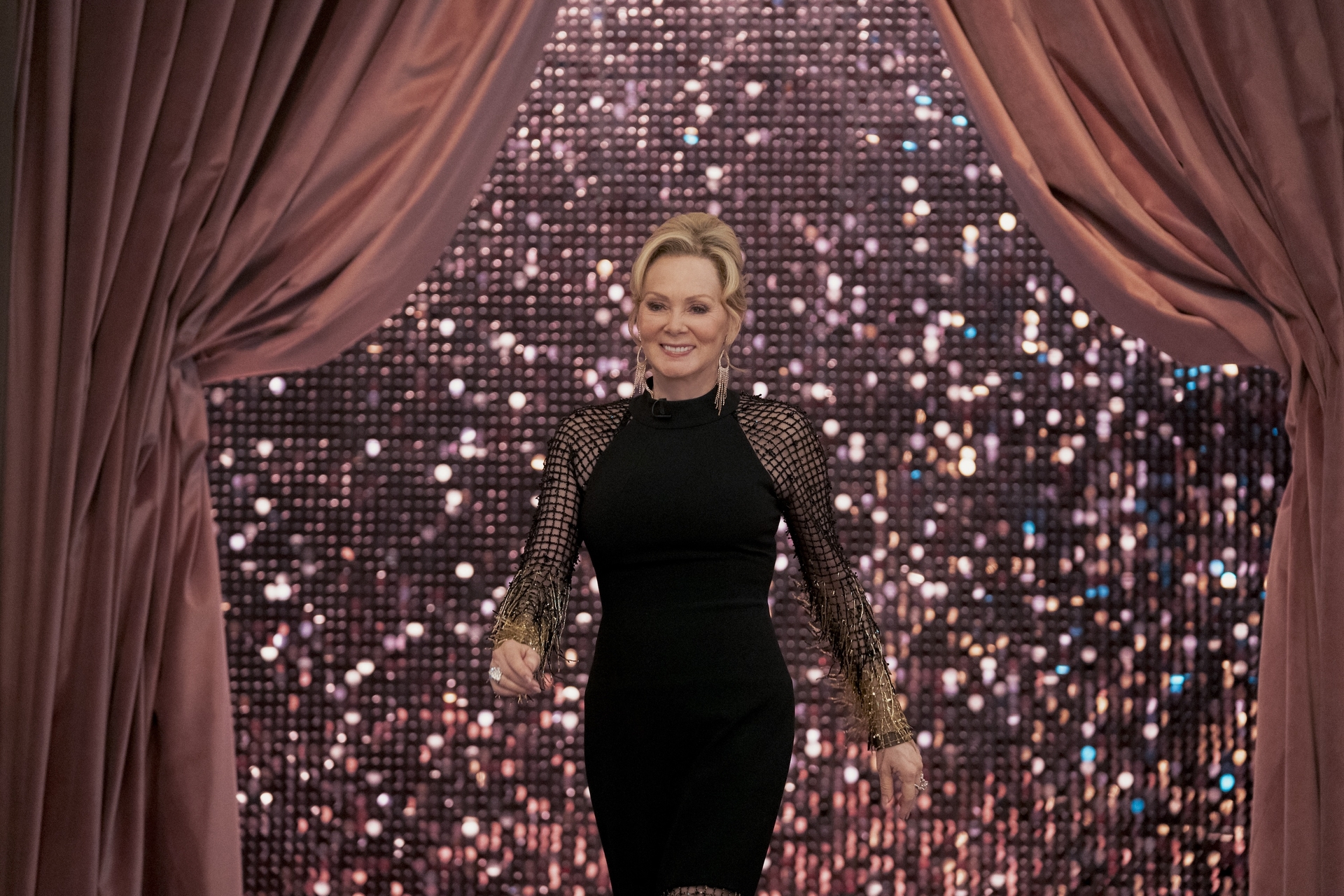

What does it mean to dress for success when success doesn’t feel the way you expected? In Hacks season 4, costume designer Kathleen Felix-Hager returns to capture the complex emotional journeys of Deborah Vance and Ava Daniels through sharp tailoring, late-night glamour, and the quiet unraveling of ambition. In this exclusive interview, Felix-Hager breaks down the evolution of Ava’s grown-up aesthetic, the symbolic power of a red Alex Perry dress, and how Hacks season 4 costume design reflects the tension, heartbreak, and personal transformation at the heart of this Los Angeles-set chapter.
Spencer Williams: I’m so excited to talk about season four. It feels like we were just chatting about season three a couple of months ago.
Kathleen Felix-Hager: I know, time flies!
Spencer Williams: Every time we talk about Deborah and Ava, they’re on some kind of journey. Season one was the evolution of this Vegas showgirl. Season two, they’re on the road. In season three, they’re chasing the dream of a late-night show. And in season four, they have the dream—but it comes with a lot of hardships. Deborah and Ava are not in a good place, which sucks to see, but also makes for such great storytelling.
What did those early conversations with the showrunners look like in terms of identifying the mood and shaping the storytelling through costume?
Kathleen Felix-Hager: We talked a lot about Ava’s evolution at the start of the season. Now that she’s the head writer, she’s elevated her look—she has more disposable income, and she’s trying to present herself in a more professional, polished way.

Even though Deborah and Ava are really at odds this season, I think both of them are trying to figure out what to do after achieving the dream. They never really talked about what the show would be once they got it. So at the beginning of the season, they’re both scrambling a bit—kind of like fish out of water. They’re in an environment neither of them has been in before.
Hopefully, that sense of displacement comes through in the costumes. With Deb’s late-night look, we talked about how to make it distinct from her Vegas and stand-up styles. We put her in a lot more dresses this time.
There’s even that bit where they saw off the desk so you can see her legs—she’s leaning into a more feminine late-night host vibe, even though early on she says, “I’m not a woman, I’m a comedian.” Still, we see her in more dresses than ever before.
Spencer Williams: That brings me to my next question—let’s talk about Deborah Vance. She’s in a lot more tailored suiting this season, too. I feel like she’s being more intentional about how she presents herself, which ties into what you were just saying. That was clearly a deliberate shift this season?
Kathleen Felix-Hager: Definitely. Every season, she steps more into this role, so she’s dressing for it. She’s in more tailored suits now. We still get a bit of that classic Deborah Vance embellishment—some sequins here and there—but it’s more restrained.

I was really mindful of her jewelry this season, too. We see a lot of close-ups, so she wore some beautiful vintage earrings. In fact, I’d sometimes build an outfit around the jewelry just because it was so fun to do.
I really feel like each season reveals a new facet of Deborah Vance.
Spencer Williams: It’s incredible how she continues to grow and evolve, even after four seasons. I would imagine that gets tough over time, but you and your team always figure it out.
In episode one, one of my favorite costumes is the red dress that Alex Perry red dress Deborah wears. I love a red dress moment because there’s always great, subtle storytelling in it. In that scene, Deborah feels like she’s just steaming with rage, but also radiating power. She was giving major devil vibes.
Kathleen Felix-Hager: I know! It’s so funny—maybe subconsciously that was part of it, but I wasn’t consciously thinking “devil.” Still, it totally plays into the imagery.
I’d had that red dress for a few seasons, and we just never found the right moment for it—until now. It felt perfect. No one else was wearing red, so she stood out. You could see cleavage, see her legs—it’s just a really sexy dress. And then there’s that red fur coat she throws on at one point—I loved that whole look.

Red always draws the eye on camera, and I wanted her to be the focal point of that scene. Then Ava walks in wearing this little baby white T-shirt, and it’s like—devil and angel. But who’s who? You don’t quite know.
Spencer Williams: You can’t help but be mad at both of them—but at the same time, you’re like, “Ugh, they look so good.” Especially Deborah. It’s hard to stay mad when she’s dressed that well.
At this point, you’ve worked with Jean Smart through four seasons, plus that bonus episode of Veep we’ve talked about. How has your collaboration evolved? When you’re gearing up for season four, do you two already feel locked in creatively?
Kathleen Felix-Hager: Yeah, I think there’s definitely a shorthand between us now. We talked a lot early on about how late night would look for Deborah. Jean wanted to be in more dresses this season—that was important to her.

She really trusts me now, and I trust her instincts too. Our fittings are always full of conversation. Sometimes we don’t have a specific look in mind—we’ll just try on a bunch of different pieces, mix and match, take photos, and review them together.
When new script moments come up, I always check in with her—“What do you think about this here?” “Does this feel right there?” It’s a really easy, collaborative, and trusting relationship, and I’m so grateful for it.
Spencer Williams: It’s clearly a partnership that works—and we’re all better off because of it.
One thing we don’t see very often is Deborah Vance being truly down on herself. Of course, there have been emotional arcs before, like with her sister, but this season it really feels like the situation takes a toll on her.
But even “Deborah Vance depressed” is still far more elevated than, like, me on a good day. So it looks different! That’s such an interesting challenge. How do you convey those deeper emotional lows through her clothing—especially when she’s never going to show up in sweatpants and a baseball cap?

Kathleen Felix-Hager: Right—definitely not! But the evolution continues. She does get quite out of sorts.
Deborah Vance might be struggling, but she still has her cashmere sweats, cashmere hoodies, and a beautiful collection of silk pajamas.
Emotionally, this season is really hard on her. Her relationship with Ava is painful—they’re not in sync, and they both depend on each other emotionally. They don’t have traditional partners, but they do provide that kind of support for one another—approval, comfort, validation. So when they stop giving and receiving that from each other, it’s deeply painful.

We see Deborah start to fall apart as a result of it. As the season progresses, you’ll notice her unraveling—personally and creatively—and the toll that takes on their partnership.
Spencer Williams: We touched a bit on Ava earlier. She’s now the head writer, which comes with a lot of responsibility. I wouldn’t say Ava’s ever been flashy with her fashion, but you can feel her stepping into this new role. She kind of has to—she’s showing up on magazine covers now.
Kathleen Felix-Hager: Exactly. This season, we put her in a lot more great, menswear-inspired tailored trousers. I used some brands I hadn’t used on her before and did a lot of vintage shopping. It’s a slightly more sophisticated silhouette for Ava, but still her.

At one point, she finally ditches the brown leather backpack she’s had since season one. Instead, she carries a used—but still really nice—Louis Vuitton tote. It signals that she’s in a different place professionally and can afford to treat herself to some nicer things.
Spencer Williams: It’s like a graduation of sorts.
Kathleen Felix-Hager: Yeah—she’s trying to grow up, she’s trying! It’s interesting. Ava’s character really does evolve, and you see that through her costumes.
As you do in your twenties, she’s changed and grown each season. And now, she’s at the tail end of that decade. Her costumes reflect that growth.

Spencer Williams: Oh, absolutely. Watching the show over the past four or five years, it’s so clear.
Okay, one moment had me laughing so hard I could barely breathe. First of all, just seeing the show take place at the Americana is hilarious in itself. But then—Ava coming down the escalator and running into Deborah? And she’s wearing those shorts, which I swear I own… And Deborah says, “You’re not funny enough to be dressing like Adam Sandler.”
That line destroyed me. Was that in the script? Or did you have the shorts and build from there?

Kathleen Felix-Hager: That line was in the script, so we worked backward from there.
We pulled a pair of basketball shorts, and those shoes—she’s actually worn them in past episodes. Then we found that great camo long-sleeve tee. Every time I saw that look, even in the dailies, I couldn’t help but laugh.
But also… she looks cute! You believe she probably just rolled out of bed in it, threw on some shoes to go grab coffee. Her hair’s tousled. And then there’s Deborah, in her aqua caftan, completely ready to whisk Ava off to Vegas. The contrast is just perfect.

Spencer Williams: I just looked at the photo again—I’m saving it as my iPhone wallpaper. I have it here; it’s happening. It’s such a funny, brilliant moment.
And speaking of LA, I love how rooted this season is in the city. You’re based in Los Angeles, right? Have you spent most of your career there?
Kathleen Felix-Hager: Yeah—I was born and raised in Los Angeles. This is my hometown. I’ve worked in a few other places, but most of my work has been here in LA. And this season definitely felt like a love letter to the city.

Spencer Williams: It dives into writers’ rooms, producers’ offices, and agents. We even go to Universal Studios! As someone who knows this culture so well, did you feel like you were able to bring some of that personal experience into the costumes and storytelling?
Kathleen Felix-Hager: Absolutely. The production’s always been based in Los Angeles. We go to Las Vegas every season, but for the most part, we shoot in Los Angeles for the Vegas locations.
It was also bittersweet—we were filming during the fires, and we lost several of our regular locations, including Deborah’s LA mansion. So we all felt the weight of that.

But being able to see these iconic spots—those real LA restaurants, the places people actually go—it felt like we were celebrating the city, not in a touristy way, but in a lived-in, authentic way.
It really reflected the Los Angeles that locals know and love.
Spencer Williams: Yes! It added to the realism—it just felt very believable. Like home. It led to a really proud moment. Thank you so much for talking with me. I loved this season, and I can’t wait to see what is next. As always, I just love getting to chat with you.
Kathleen Felix-Hager: I feel the same way—thank you, as always, Spencer!
Hacks Season Four is Now Streaming on Max


