

A new cast of guests has checked in to The White Lotus, and with them comes a parade of hypnotic, sun-drenched costumes that reveal far more than just personal taste. For the third season, set against the lush backdrop of Thailand, Emmy-nominated costume designer Alex Bovaird returns with her signature blend of satire, glamor, and psychological insight. In this exclusive conversation, Bovaird unpacks the design journey behind characters like the bohemian Chelsea and her sun-frazzled partner Rick, the sleek and mysterious Chloe, and the visual language that sets this season apart — from the show’s unofficial no-denim policy to her use of textiles that shimmer, clash, and seduce.
Spencer Williams: I’m so happy to welcome back my friend, costume designer Alex Bovaird. Hey Alex—good to see you again.
Alex Bovaird: Thank you, Spencer! Likewise. You’re looking good.
Spencer Williams: Oh, thank you. It’s been a while since we last spoke about The White Lotus—back in season one. I have to ask, how has the show changed your life since then, especially in terms of the fan response?
Alex Bovaird: I feel very lucky to be part of a cultural zeitgeist like The White Lotus. It’s such an honor to be playing in Mike White’s sandbox—everyone loves this show, and it’s a special experience to work on something people are genuinely enamored with.
You can put just as much effort into other projects, but they don’t always get the same recognition. So I’m truly thrilled to be part of this.
Spencer Williams: And we’re thrilled you’re part of it, too. This marks your third season working with Mike White—clearly, something’s working. What makes that creative relationship click so well?
Alex Bovaird: We speak the same language. Mike is a pure creative force, and the way he works is very structured—we start with all the scripts fully written, and they rarely change. Occasionally, there are minor updates after dialogue adjustments, but overall, everything is set early on.

That kind of clarity makes my job so much easier. I’m in a privileged position where I can start prepping with the full picture in mind. Of course, things shift occasionally, but by and large, the foundation is solid.
Mike also trusts me. He’s juggling so much—he’s the writer, director, and showrunner—so he relies on his collaborators to handle the details. When I place a costume, he knows I’ve thought through things he doesn’t have time to consider.
Spencer Williams: You can really see that synergy—not just between you and Mike, but across the whole production. It comes through week after week.
For this third season, we’re heading to The White Lotus in Thailand. How do you mentally transition from Hawaii to Italy to Thailand—while still keeping that cohesive White Lotus feel?
Alex Bovaird: Each season needs that cohesive tone that says to the audience, “Here we go again—buckle up.” We retain some familiar elements, such as the arrival scene, where all the characters are introduced, including the hotel manager and staff—the structure remains. But then the location transforms everything.
The landscape is a big part of the story. I knew about Thailand, pretty far in advance, which helped. I’d been to Thailand when I was younger—backpacking for nine months across Asia—so I already had some personal reference, although it was very different from a five-star resort experience.

Once I arrived in Thailand, I visited temples, absorbing the colors and smells, and let them all seep into my costumes. It’s about building from memory, digging online, then immersing myself in the location—and translating that into costumes that reflect the geography and culture of the place.
Spencer Williams: I’d love to dig deeper into the stories behind the choices you made for these characters. Let’s begin with Belinda, who returns to the White Lotus—this time in Thailand—hoping to grow her practice beyond her experience in Hawaii.
I get the sense that she’s a little self-conscious, but she’s also really trying to let go and enjoy the moment. There’s clearly some internal conflict still bubbling underneath. Am I onto something? And how did you explore that visually through costume?

Alex Bovaird: Yes, totally. We first met Belinda in season one, and now she’s back in season three as part of a work exchange program. She’s never left the U.S. before, so this is a huge moment for her. She’s technically a guest this time—though she’s in one of the tight little rooms at the end of the hotel—but she still gets to eat at the restaurants, receive treatments, and participate in guest activities.
So, she packed with that mindset. She’s prepared to relax a little, enjoy herself. When she arrives, she’s in something simple and comfortable—a floral dress. The prints are vibrant, the fabrics are breathable because it’s extremely hot, just like in Maui. Her color palette reflects hope and optimism—warm and sunlit tones.

In many ways, she’s the audience’s entry point into this season. A lot of the plot flows through her. So, we wanted her look to feel familiar and comforting. She wears florals that echo back to her time in Hawaii, but as she settles in, her evening looks push things a little further. She dresses up more, because she doesn’t want to feel like an outsider—like a Cinderella figure who has to run back before midnight. She wants to feel like she belongs.
Spencer Williams: Yes, that totally comes across. At dinner, she finally gets to loosen up, feel like part of the crowd.
Alex Bovaird: Exactly. We dressed her just as glamorously as the other guests, because by then, she feels like she’s earned it. She deserves to be there. And then, of course, the story takes that twist. When she decides to team up with Greg—or Gary—and extort money, you suddenly see a different side of her.

She’s been so humble, so grounded, that when she takes this turn, it really hits. It was almost a bigger twist for me than the season’s murder mystery. She chooses not to expose Greg for killing his wife and instead takes the money—turning her back on her fellow masseuse, Pornchai, with whom she’d talked about opening a spa. It mirrors what happened with Tanya in season one, but this time Belinda becomes the character we didn’t expect—someone who joins the White Lotus elite.
Spencer Williams: And honestly? I was rooting for her the whole time. I was like, “Yes, Belinda—take the money, hook up with that man, ride off into the sunset!”
Alex Bovaird: Right? And she does. By the end, she’s wearing expensive jewelry, and she and Zion are looking very Miami Vice as they speed away in the boat. Her costumes get flashier, more confident. It was a great ending for her.
Spencer Williams: It really was. I was just so happy to see her thrive—and she looked great doing it.
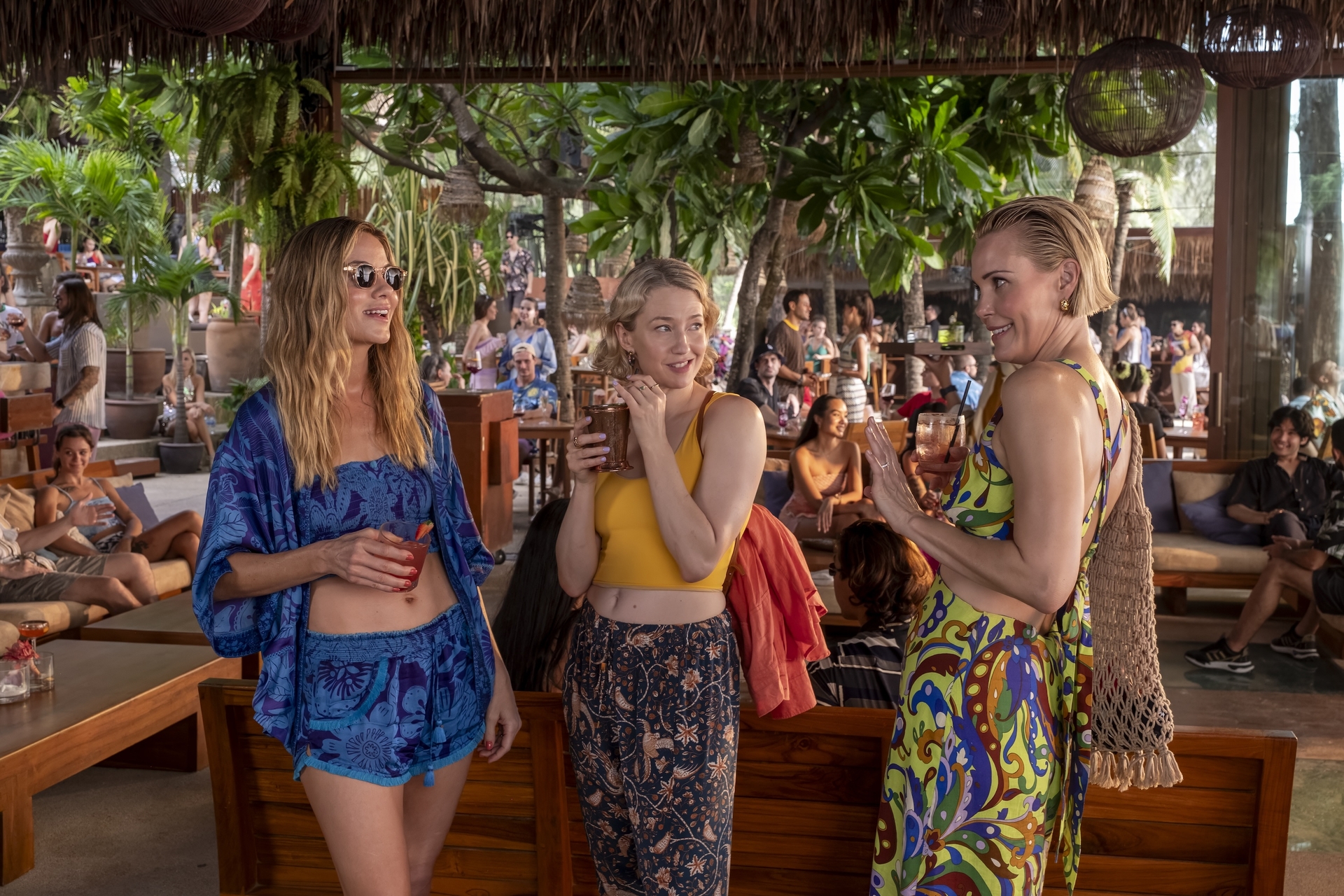
Now, let’s talk about my favorite group this season: the Girls Trip Trio—Jaclyn, Laurie, and Kate. I’m obsessed. There’s this really clever costuming detail where they almost feel like doppelgängers—interchangeable in some ways—but also clearly trying to one-up each other. Like Laurie seems a little worn down, while Jaclyn is absolutely peacocking. How did you approach designing for this kind of dynamic?
Alex Bovaird: That was such a fun challenge. Mike wanted them to feel somewhat interchangeable. There’s this sense that they blur together in the way close friends sometimes do. They admire each other’s outfits, try to keep up, and there’s a bit of a competitive edge—especially in how they dress for the pool, the designer handbags, the flash. It’s this “everything’s perfect” performance that feels very specific to certain American friend groups.

So we leaned into that. We echoed each other’s silhouettes and color palettes. The goal was to make their looks desirable—something the audience might aspire to—so you’d want to spend time with them and maybe even see yourself in them. And then, of course, the cracks start to show.
Laurie doesn’t have it all together. Her daughter’s struggling, her marriage fell apart, and she’s exhausted. Jaclyn pretends everything’s fine, but there’s tension under the surface. The fame isn’t as shiny as it appears. So as those realities surface, the costumes reflect both the image they’re projecting and what’s really going on underneath.

Jaclyn was our butterfly. Her looks were always bold, bright, colorful. She’s addicted to luxury labels—there’s a giant Gucci hat, a head-to-toe Valentino moment. She’s the one in the trio who dresses for maximum attention.
Kate, on the other hand, is more conservative, more polished. She got the Cartier Love bracelets—a quieter choice that still says “money” but with restraint. She’s a perfectionist. Laurie’s somewhere in between—relaxed, slightly disheveled, more realistic.
Designing them was like dressing one single character with three facets. I actually called them my Sex and the City girls. Even though you barely see their shoes, they had new ones for every look. The accessories were endless—layers of jewelry, sunglasses, bags. It was extravagant and super fun.

Spencer Williams: There’s another family on this island who seem like they have it all together—but they’re a complete hot mess, and I kind of love them for it. I’m talking about the Ratliff family. Each character has a strong personality, but they’re all tied together by this air of Southern wealth and tradition. There’s a lot of flaunting their social status—even if Piper is working hard to pretend that’s not what’s happening. So first, talk to me about costuming the Ratliff family as a whole. And then let’s get into Victoria, because the internet is obsessed with this character. I’d say she’s the breakout of the season.
Alex Bovaird: Yeah, I agree. It’s hard for me to pick a favorite because I truly loved dressing all of them—I love all my characters. And honestly, each group could have their own spinoff. I miss them already.

The Ratliffs were a perfect example of one of Mike’s recurring themes: pulling back the veil. Just because someone has money doesn’t mean their life is any less messy—in fact, it often is. The Ratliffs very much think they’re better than everyone else, and that arrogance runs through everything they do. That attitude was key in shaping their visual identity.
Costume-wise, they needed to feel cohesive as a family unit, but with distinct nuances. Piper, for instance, is more ethereal and grounded. We wanted to hint that maybe there was hope for her—that she wasn’t completely obsessed with status, materialism, and prestige. But of course, it turns out those things matter to her too. She doesn’t end up staying in Thailand after all, even though she made a big show of wanting to.
And then there’s Victoria—Parker Posey’s character—who really struck a chord with viewers. Even during filming, I knew she’d be iconic. She had so many meme-worthy line deliveries, and it was clear she was going to be larger-than-life in the finished series.

Parker was amazing to work with. She’s very collaborative, with a background in theater where she used to create her own costumes. So she was highly engaged in the design process and had a strong sense of how Victoria would carry herself. She was cast early, which gave us time to talk through her character in detail. Parker has a fantastic sense of style and brought so many thoughtful ideas to the table.
We also got to lean into one of our White Lotus favorites: the caftan. So many flowy prints! Mike really encourages bold choices—he wants each season to feel joyful and colorful. I don’t have to limit myself to safe neutrals or subtlety. We definitely walked the line of leaning into stereotypes at times, but it’s about finding that sweet spot—where the costumes don’t overwhelm the story but absolutely enhance who these people are. And in Victoria’s case, her looks really helped sell her role at the resort. She’s not getting down and dirty. She doesn’t even really know where she is—she calls it “Taiwan.” She has no interest in leaving the hotel grounds. She’s resentful about the yacht excursion and only agrees to visit the monastery because she wants to sabotage her daughter’s plans.

So her costumes reflect that attitude. She’s not in a bathing suit, she’s not wearing anything too structured—she’s just lounging around, getting her treatments, looking fabulous.
Spencer Williams: She never feels too over the top. Instead, she feels empowered and commanding, like the kind of guest the resort staff would immediately clock as that woman—the one they’re all talking about in the staff group chat. You just know everyone’s been warned to keep her happy. She’s totally running the place. She absolutely deserves a spinoff. I need her to return in, like, two seasons. I’d be so happy.
Alex Bovaird: Oh, I know. I really want an All-Star season.
Spencer Williams: Yeah, that would be such good fun.

Alex Bovaird: Mike talks about it all the time, so hopefully it’ll come to fruition.
Spencer Williams: Fingers crossed. Maybe Victoria comes back after her divorce from Timothy—who is clearly heading to prison—and she needs a whole new round of treatments. But let’s pivot to a couple characters who probably won’t make the All-Star cut: Chelsea and her cranky boyfriend Rick—who I absolutely love.
Chelsea has that British bohemian thing going on, and Rick looks like he’s just trying to make it through the day without a full-blown breakdown—always in his Hawaiian shirts. Can you talk about designing these two? While their energies are wildly different, I feel like they actually ground each other in a really sweet way. They work as a unit.
Alex Bovaird: Totally. And honestly, if you went back in time, they could’ve easily shown up in another season. You could imagine them in Bali in 2020. I really loved them—and working with Aimee and Walton, who played Chelsea and Rick, was such a joy. They’re awesome people, which made the process that much more fun.

We talked early on about Chelsea keeping her Manchester accent. That choice really helped shape her character. She’s this new-age, yoga-tantric, astrology-loving free spirit—but because she wasn’t a California girl, it gave her a slightly unexpected edge. That kind of contradiction made her really interesting.
And that’s when everything really started clicking costume-wise. Aimee Lou brought such a distinct energy to Chelsea, and it synced perfectly with everything we were doing visually. She’s floaty, hippie, colorful—very bohemian and hopeful. Like most of our characters, she had tropical prints in her wardrobe. No one really escapes those in White Lotus. Even Timothy Ratliff sneaks them in—he wears Tommy Bahama, but only in solid navy.
Spencer Williams: He’s always one second away from throwing on a full suit and tie.

Alex Bovaird: Exactly! Even when he’s relaxed, he’s still kind of structured—with a hint of rainbow-colored linen. But with Chelsea and Rick, we leaned into the idea of them being free spirits, drifting around the world. Rick is definitely running away from something, and Chelsea is running toward something. They’re these faded, star-crossed lovers.
We wanted them to feel different from the typical White Lotus guest. They arrive a little bedraggled, less polished. Rick’s clothes—mostly vintage—look worn and faded, especially compared to characters like Craig and the shiny, curated women around them. Chelsea and Rick wear more muted, relaxed tones. They feel like part of the island itself rather than tourists invading it.

Spencer Williams: They’re more relatable than a lot of the other guests. I mean, I watch and think, “Yeah, I’d probably be Rick on this island.” There’s just something very real about them.
Alex Bovaird: They’re not performing or posing, like so many of the others are.
Spencer Williams: Which brings us to two people who are maybe a little less relatable—Greg and his stunning new girlfriend, Chloe.
I laughed when I looked it up, but I think Greg has actually been in more episodes than anyone else across the three seasons. So what was it like bringing him back? He’s doing pretty well for himself now, clearly. It seems he came into some money—and Chloe is such an interesting character. She knows exactly what she’s doing, and she owns it. She’s fashion-forward, confident, commanding. It feels like you really got to play with her character visually—and you can definitely see why Greg is keeping her around.

Alex Bovaird: Yeah, so Chloe is played by Charlotte Le Bon, and the first look we committed to for her was that striking pink ensemble on the yacht. That was her first scene—and it really set the tone.
She came into the production a little later, so I brought tons of clothing options with me, just in case. Shooting on an island in the middle of the sea—in Thailand—means it’s not easy to source interesting pieces last minute. So I came prepared.
We landed on that bold pink look, and I remember Mike White and I talking afterward. He said, “I want every outfit to feel like that”—not over-the-top or distracting, but bold and elegant. A look that makes you think, Wow, that’s a confident, beautiful woman. So from that moment on, we kept pushing in that direction.

Chloe is very much a foil to Tanya. Where Tanya is chaotic and often wears loud, busy ensembles—sometimes mismatched or borderline ridiculous—Chloe is effortless. Chic, pulled together, stylish, but still bold. She takes risks in a calculated way. She’s powerful. She knows exactly what she’s doing. And she loves spending Greg’s money, so every outfit needed to reflect that.
She’s also a global traveler, someone who knows her way around designer brands but also appreciates an under-the-radar local find. She’s always striding through the scene like she owns it—and in many ways, she kind of does.

Spencer Williams: With The White Lotus, color and textiles always feel especially important to the storytelling. How did those elements influence your design process in Season 3? How essential were they this time around?
Alex Bovaird: They were incredibly important. We actually have a few unwritten rules on White Lotus, and one of them is that we try to avoid denim. It just doesn’t quite fit in this hyper-elevated, escapist world we’re building. It’s funny—I’m working on another project right now where everyone is in blue jeans, so it’s quite the contrast.
On White Lotus, we aim to avoid overly casual dressing. I’ll sometimes push to get someone into a simple T-shirt just to create visual balance—so the breakfast scene doesn’t feel like everyone’s ready for the red carpet. But by Season 3, expectations are so high that it’s tough to get anyone into something that doesn’t feel aspirational.

We try to imagine a world where people still dress for the occasion—which isn’t necessarily how real people behave anymore. But for White Lotus, that heightened reality works. The goal is to maintain a vibrant visual language—electrifying, shiny, rich, blingy, and lustrous. So we’re drawn to sequins, sheen, texture, contrast—anything that makes the scene pop and feel like a dream. That means consciously steering clear of items like cotton and denim.
Spencer Williams: Let’s talk about something really exciting—the recent White Lotus x H&M capsule collection, which is now completely sold out. First of all, huge congratulations! That’s an amazing achievement. How did that collaboration come about, and what was that process like for you?
Alex Bovaird: Thank you! It was really cool to be a part of. Warner Bros. had been exploring partnerships with different fashion brands to tap into the marketing potential of their shows. I work with Linda Kearns—who represents costume designers in securing branding deals—and we started having some early conversations with Warner Bros. to see how we could collaborate.

I’ll be honest, I had to advocate for myself a bit. Costume designers aren’t always brought into these kinds of partnerships, but I pushed to be included. I wanted to make sure I had a voice in any potential collaboration, and thankfully, it worked out.
H&M saw the value of working with me directly, and while we were filming in Thailand, I was simultaneously collaborating with them. It was an amazing experience, because I was able to pull inspiration straight from what I was seeing around me—the local colors, textures, and aesthetics—and infuse that into the capsule collection.
The idea was that you could pack everything in the collection into a single suitcase and be ready for a White Lotus-style holiday. Or you could just mix and match—throw on the bikini top with your jeans and have your own little island night wherever you are.
Of course, it was a bit of a process—these are massive companies, Warner Bros. and H&M—and then there was just me in the middle of it. So it took some time to pull it all together. But creatively, it was a dream. The team at H&M was amazing. Their designers really got the vision, and together we created something I’m incredibly proud of—something that truly reflects the White Lotus vibe.
I really hope this sets a precedent. More brands should work directly with costume designers. It just makes sense.

Spencer Williams: Absolutely. I mean, you’ve worked on all three seasons of White Lotus, alongside your incredible crew. Who better to lead a collaboration than the people actually designing the look of the show? It seems like such an obvious choice.
Congratulations again—we’re all so proud of you, and of course a big shout-out to Linda, who’s been such a champion not only for you, but for so many designers. I can’t wait to see what’s next. Alex, this has been such a joy. I always love talking with you. Costume designer Alex Bovaird—thank you so much for being here.
Alex Bovaird: Thank you for having me, Spencer.

