

Down the winding Witches’ Road, where all that’s bad is good and glory waits at the end, costume designer Daniel Selon conjures a world both wicked and wondrous. In this rich and revealing conversation, Selon returns to The Art of Costume to chat about Agatha All Along and reflect on the creative power, detail, and transformation behind every stitch. From the tragic grandeur of Lady Death to the rise of Billy Maximoff and Agatha’s journey through centuries of costume history, we dive deep into the craft, symbolism, and spirit woven into each look. As fans continue to burn, brew, and build in celebration of this spellbinding series, Selon shares what the project unlocked for him as an artist—and why he’s just getting started.
Spencer Williams: I am so excited to welcome back my friend, costume designer Daniel Selon.
Daniel Selon: Hey Spencer, thanks for having me. I’m so happy to be back to talk more about Agatha.
Spencer Williams: What a life you’ve lived since we last talked. Ever since the show dropped, the response has been incredible. How has your life changed since the series premiered?

Daniel Selon: Wow. My life is quite different. As artists, we’re often fragile and insecure—we pour so much of ourselves into these projects and send them out into the world, not knowing how they’ll be received. Sometimes there’s no response at all. But this? This was a big deal for me.
It was a huge opportunity—a chance to level up, spread my wings, and show everything I could do. There were so many different elements in the show that really pushed me. It was intimidating at times, but I rose to the challenge. To then have the world respond with so much love and appreciation—for the details, the layers, the effort behind every costume and character—I couldn’t have predicted that. I didn’t expect people to really see us or celebrate what we did. But they did. And the love keeps coming. My Instagram has basically turned into an Agatha archive. I don’t even have an identity anymore—it’s just Agatha art all the time!
Spencer Williams: That’s the name of the next series: Agatha All the Time.
Daniel Selon: Exactly! It’s just me reposting fan art. But it’s been so lovely. The fans are the people I hoped would connect with the show—cosplayers, creatives, young queer kids, older queer folks. People from all walks of life have reached out to say that this show meant something to them, helped them, or inspired them. And that connection… It’s everything I hoped for and more.

Spencer Williams: It’s beautiful. The show was so powerful, and just from sharing clips and conversations with you over the past year, I could feel the love and excitement. I was getting the notifications too—people sharing their builds, their fan art, asking questions. I’m just so happy for you and the team that made it all happen.
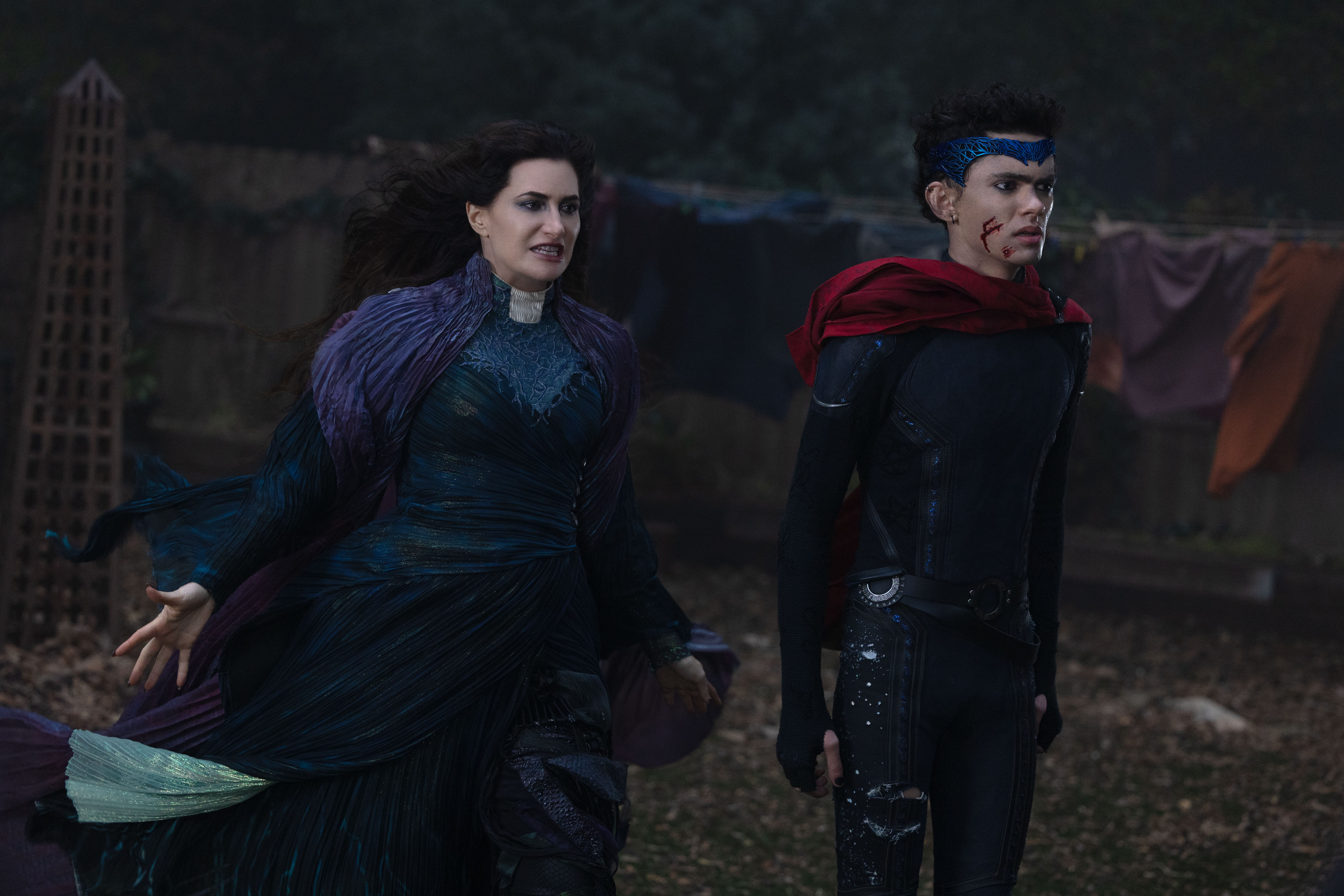
Let’s actually pick up where we left off—with Episode 8, Follow Me My Friend/To Glory at the End. We arrive at this epic conclusion to the Witches’ Road storyline, with the final battle between Agatha and Rio—Lady Death—plus a surprise assist from Billy, who has really come into his power. Lady Death’s costume is easily my favorite of the entire series—well, maybe tied with one other. The roots, the almost Sith Lord-style hood… It’s packed with detail. You only catch glimpses of it, but it’s unforgettable. Tell me about creating that look.
Daniel Selon: This costume was a real collaboration. We started with some original key art, and then there was beautiful concept work by Keith Christensen, who’s worked in Marvel’s visual development department for years. His designs had this almost religious quality—central figures that echoed imagery of Mary or the Virgin of Guadalupe. That influence really helped shape the silhouette.

There was also another concept that showed a dark character nestled inside the hollow of a tree, and that really stuck with us. So we started pitching all these different cloaks—death imagery, silhouette clarity—but I didn’t want to overwhelm tiny Aubrey with just yards of draped fabric.
We turned instead to 1920s fashion, specifically the cocoon coat by designer Paul Poiret. These coats had dramatic volume and beautiful sleeve shapes, and that felt right for the character. We adapted an original 1920s pattern to create the cloak. The fabric itself was amazing—it had this bark-like texture with both matte and slightly shiny areas, which made it feel alive, like tree bark.
When Aubrey was wrapped up in it, the asymmetrical closure gave the illusion that she was this creature curled inside a tree. The bodice beneath was designed as the dark shadow version of her green witch costume. Originally, she embodied growth—moss, lichen, vines—but in this final form, she crosses the veil. The living elements are gone, and what’s left is calcified. Dead. Immovable. Undeniable.
I pulled a lot of inspiration from lava rock—the way magma curls, spins, flows, and then freezes. When she was the green witch, it felt like she could walk through a forest and command nature. Now, it’s like she could freeze time. She could stop your life in an instant. Her costume reflects that—stillness, darkness, finality. The flower at her heart in the earlier design has transformed into a literal black heart, as written in the script. We used a piece of black obsidian glass, captured and caged at her chest.
And Aubrey—she just crushed it. In her first fitting, she was already oozing around the room, feeling it, striking poses with these dramatic hand gestures. I have hundreds of photos of us figuring out which fingers would wear the little metal tips. I wanted her to be able to point with intent—almost like a laser pointer. Something skeletal and severe. Metal just felt right.
Then there’s the crown. I saw it early in the process. I knew she had to read as royalty—she needed status. We wanted it to feel more like thorns than horns. Not quite a crown of thorns, but something with edge and meaning. Obsidian glass was again the inspiration.
The shapes came together through hours of work with my illustrator, Xander Smith. He’s a brilliant 3D sculptor, and we’d just sit there spinning the model, adjusting every detail until we found the perfect form.

Spencer Williams: Costume designers love to save the best for last—and this one? This was it. The moment I saw the episode, I was like, “Damn it, I need to call Daniel again.” It’s so tragically beautiful.
Let’s talk about Billy, who shows up in that final scene. Marvel Comics readers know the Wiccan character well, and you really captured that spirit in the costume. It shows Billy’s power, but also this timeline—his evolution. Going all the way back to WandaVision, we start to see his colors slowly coming together. Now it’s here, fully realized.
Plus, you got to work on this super cool queer superhero. That’s such a beautiful thing.
Daniel Selon: Yeah, with the introduction of this version of Billy—stepping into his superhero identity as Wiccan—I took it very seriously. I knew what it meant for the MCU timeline, for the fans, and for me personally.
There was a special, almost parental connection for me because I had worked closely on the kids’ looks back in WandaVision. I designed Billy’s Halloween costume in that episode, and now, years later, to be the one crafting his official superhero look—it was such a meta, full-circle experience.

Throughout, we were always balancing with Mayes C. Rubeo, who’s an incredible designer, how to bring in the colors without being too on-the-nose. So to go from draping that little Halloween cape and hood to now building the real deal? It was surreal.
I wanted to respect the comic book design. There are certain elements that are really consistent in the source material—his circular belt, the galaxy that lives in the side panel of his pants. In the comics, it’s not a print; it is the galaxy. I loved the epic quality of that.
And then, of course, the asymmetrical cape and hood—that’s iconic. It’s sleek and sexy. Who doesn’t want a cape that slings off to one side? But it’s a narrower cape than you’d see with Thor or Doctor Strange. Billy is still a young man. He’s still growing. He has somewhere to go.
That was part of the intention—to avoid going full superhero with molded rubber or sculpted armor. We wanted him to still feel like the goth teen we first met. So there are details that carried through—for example, the rip in his pants that came from his jeans in WandaVision. That detail made it into this suit. It’s not just costume—it’s identity.
But everything else? It’s an upgrade. The rune symbols that were in his sweater are now fully realized—screen-printed in three dimensions onto leather across his chest. And in those symbols, we embedded references to Wanda’s crown, Vision’s mind stone, and the way his magic ripples through space.

For the ripple design, we were inspired by Damascus steel—when it’s forged, it creates these concentric rings that look almost like wood grain. We took that idea and applied it to the magic on his chest. So Wanda’s crown, for example, sits at the center of one symbol, and the ripple effect of his power spreads outward, interacting with the other runes.
That kind of layered symbolism—that’s the stuff I love. It creates story. It gives Joe something to feel proud of when he wears it on set. And once he got up on the wires for that dramatic descent—it was electric. You could feel the power in the room.

Spencer Williams: My jaw dropped when I saw it. I want to talk about my favorite episode of the season: Maiden Mother Crone. The first half feels like its own period short film. Where in the shooting timeline did this fall—early on, or later?
Let’s talk about Agatha in this episode. We meet her in a really vulnerable space. She’s just blending into the world, looking after her son. Her color palette is so soft here. In terms of historical reference, where are we placing Agatha at this point in the story? What kind of research guided her costume here?
Daniel Selon: This moment is set in the 1750s. The silhouette from that period was actually quite voluminous—full skirts, aprons, fitted bodices. We really leaned into the materials of the time: linens, cottons, and some wool.
We stayed within Agatha’s established color palette—teals, purples, and all those shades in between. Her bodice here is a teal green, her shoes are purple, and her skirt is a dusty mauve.
Spencer Williams: She’s consistent.
Daniel Selon: Exactly! It felt like a nice way to keep her essence present, even as she’s navigating new experiences—like motherhood—as a young woman.

Spencer Williams: It leads right into one of my favorite looks. I told you I had two favorites, and the second comes when she starts working on the con of the Witches’ Road. You had the chance to visually convey the passage of time through costume—Agatha through history. That’s huge!
What were some of the specific periods or visual references you worked with for those versions of Agatha? The purple hat and black bodice—feels a little Victorian? It’s one of my favorites.
Daniel Selon: Yes! That look was actually from the 1890s. Shooting all of those costumes was such a wild adventure—we called it the “Agatha Through Time” montage—and we filmed them all in one day.
We had to decide on the time periods very early on. I revisited WandaVision to review what we’d already covered, then created a new historical timeline that wouldn’t repeat any of those visuals. Jac Schaeffer had originally written in four or five periods, but there was some overlap, so I tweaked the dates and suggested a lineup that would give us a broader range across Agatha’s life.

That 1890s costume—with the purple hat and a fitted black bodice—was incredible. There’s a corset under there with about 37 buttons up the front. The moment Kathryn put it on, she transformed. She’s amazing to work with—she doesn’t need direction. The second the costume is on her body, she just knows who the character is.
It was like that all day. Another look was inspired by the 1930s—when women were entering the workforce—so we leaned into sharper tailoring and more structure. Then there was one more where she was basically in full Bono cosplay for the rest of the afternoon. She just leaned into every single era with such ease—it was amazing to watch.

Spencer Williams: It was all so believable. That last one felt like the perfect punctuation for the whole scene. It was like a visual mixtape of Agatha’s history. Quite the homework project for you—really had to pull out your history books for that one.

So, the next big challenge—Agatha dies, which is heartbreaking—but she reappears as a ghost. That must’ve been a fascinating design challenge because it’s clearly a real costume, not just VFX. What was the technical process behind bringing that ghost look to life?
Daniel Selon: This show used so many practical effects, and we were always trying to contribute from the costume side in creative ways. We knew she would die and come back, and I wanted her return to feel like an evolution, not just a repeat of the Hero Witch look, but something elevated.
I thought: what if she comes back as light? What if she is electricity? That felt right, especially with how Kathryn Hahn plays Agatha—she’s got this sparky, high-energy presence. So we looked at stained glass windows as visual inspiration. That led to the idea of literally building light into the costume.

We worked with Dreamlux, a company in Italy that weaves fiber optic threads—basically tiny strands of glass—into organza fabric. We created a custom pattern, and they knit the exact design. Then Marilyn Madsen, my cutter in LA (she’s a genius), assembled everything.
Underneath, there’s essentially a Kevlar-like vest with battery packs and heat shields. All those fibers feed into a single bundle and connect to a strong light source, which gets really hot, so we had to make sure Kathryn wouldn’t get burned.
The shawl—an element pulled from the comics—has followed Agatha throughout the series. In episode two, when she’s recruiting the coven, she has a shawl that transforms as she moves. This ghost version was the final iteration. We used a fabric called Mima—it’s the world’s finest polyester. It’s thinner than onion skin, and when you toss it in the air, it floats and hangs like smoke. It moves in slow motion without any effects.
On set, Kathryn was glowing—from the inside out. From neck to toe, the suit carried an electric print that ran like lightning through the skirt, and the shawl floated around her like mist. It was stunning in person, and the perfect final costume in this never-ending parade of looks.

Spencer Williams: Even in death, Agatha is still showing us all up as the most fantastic ghost. It’s really incredible. The design feels ethereal, but also joyful—like she’s in a good place, even in the afterlife.
That brings us to the end of Agatha All Along, which I’m honestly sad about. Now that you’ve had a little space from the project, Daniel, what does this experience mean to you creatively? What are you taking away from it?
Daniel Selon: This project has truly been a turning point in my life. It’s put me on a new trajectory—not just professionally, but personally. The biggest thing I’ve taken from it is a deep understanding of who I am.
We all go through moments in our careers where we ask, “Is this what I’m meant to be doing? What do I really have to say?” And this show gave me the opportunity to say something. These characters, these costumes—they allowed me to express myself completely.

So when you’re looking at these designs, you’re looking at a piece of my soul. I’m grateful people responded to it, and that it gave me the confidence to know I’m on the right path. I’m grateful to have that kind of clarity—and also, yeah, I’m a witch now.
And beyond that, I feel even more driven to tell authentic queer stories. That was always our intention with this show, but seeing the impact it’s had—on fans, on the community, on the world—it’s solidified how important representation is. It tells people they belong, that there’s nothing wrong with them, and in fact, they’re magical. Superhuman. Worth celebrating.
And honestly, that’s been the effect it’s had on me, too. So I feel wonderful. And I’m ready to do more.
Spencer Williams: First of all, it came out at the perfect time. Even going back to rewatch it in preparation for this conversation, I found such comfort in it. But also, you just see so much of yourself in these characters. It’s something we’ll keep returning to—not just during spooky season, but throughout the year—because there are so many beautiful, human stories happening in this very campy, witchy, over-the-top world that we all love.
I just want to say—I think we’re all incredibly proud of you and your team. It’s such an incredible achievement. Thank you so much for coming back to talk with me. I’m so glad we got to revisit these characters. Can we just make this a tradition? Every October?
Daniel Selon: Please! Let’s do it. We could even have a little in-person screening, Mystery Science Theater 3000-style, with live commentary. That would be so fun.
Spencer Williams: I’m writing that down. It’s happening. Thank you again, Daniel.
Daniel Selon: Thank you, Spencer. You’re the best. Always great talking with you.

