
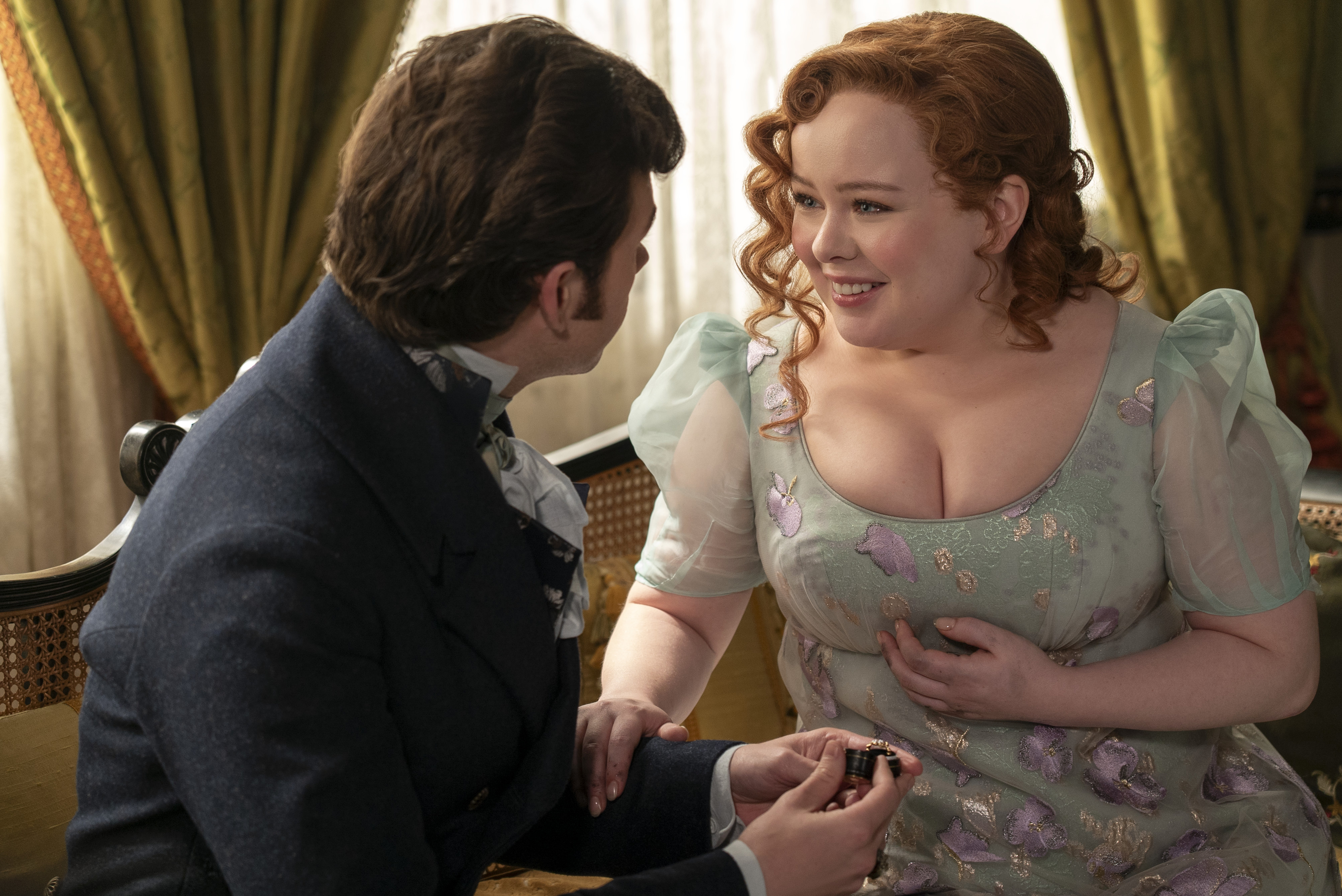

Penelope Featherington has long lingered in the pastel shadows of the Bridgerton world—but in Season 3, she steps fully into the light. With her transformation into the show’s central romantic heroine, every stitch of her costume signals a new era for both the character and the series. Costume designer John Glaser, who returned to the Bridgerton universe after shaping its first season alongside Ellen Mirojnick, reimagines Penelope’s look with a blend of Regency inspiration and cinematic flair. In this conversation, Glaser discusses crafting Penelope’s sensual new silhouette, the visual chemistry between her and Colin, and how subtle shifts in color and silhouette tell a story of power, mystery, and reinvention.
Spencer Williams: I’m so happy to be here chatting with the costume designer for Bridgerton Season Three, John Glaser. How’s it going today, sir?
John Glaser: It’s good to see you. I’m doing pretty well, actually. We’re wrapping up Season Four, so things are finally starting to slow down a little.
Spencer Williams: Oh, great—so even more to look forward to and talk about soon. But first, let’s get into Season Three. This one was special, as you returned to the series after designing the first season alongside Ellen Mirojnick, which earned you both an Emmy nomination. Before we get into specific costumes, I’d love to know: how did it feel to return for Season Three and work with this cast again—many of whom have grown alongside the show?

John Glaser: It was… I want to say great—but honestly, it was just good in a very grounded way. The first season was very experimental. Coming back for the third season gave us a chance to start fresh, to reevaluate what worked and what didn’t. If we had continued straight into Season Two, we wouldn’t have had that opportunity to step back and take in the bigger picture.
Spencer Williams: That makes sense—you got to come up for air and reexamine things. I love the Regency period; it’s so rich in history. But Bridgerton is such a massive show. What does your research and prep process look like when you’re diving into a new season?
John Glaser: We always start with mood boards. I like to include three types of reference: something grounded in real historical research, a piece of art, and then something current. If you look at Regency fashion closely, you can always pull out threads that connect to modern style.
For Season Three, we wanted everything to feel like a flower garden—lots of ombré fabrics, layers, and textures. We wanted the colors to feel fluid, almost ambiguous. Something could read as blue, green, or pink depending on the light. The idea was to create the look of a living, breathing garden—not something glittery or sparkly, but organic and soft.
Spencer Williams: I love that. Speaking of transformation, let’s talk about Penelope, played by Nicola Coughlan. This season is really her moment. When it came to turning Penelope into the season’s leading lady, what did those early conversations look like?

John Glaser: We talked a lot about how traditional Regency silhouettes weren’t doing anything for her. They didn’t highlight her body in a way that felt sensual or mature. And she’s growing up—this needed to be her coming-of-age moment.
So we created a shape that still nodded to Regency fashion but wasn’t strictly period-accurate. We actually looked to 1950s silhouettes—something that flattered her more directly. The hair helped too—longer and sexier. We wanted her to have a more sensual presence.
Her costume palette was a big part of that. She was the main reason we leaned into the garden concept. We kept her colors intentionally ambiguous—so viewers couldn’t predict what might happen. If she wore blue, people might assume she was becoming a Bridgerton. If she wore green, they’d read into that too. So we stayed away from Easter eggs.
We also broke from her original citrus tones and did it fast—no gradual shift. It was a dramatic visual evolution.
Spencer Williams: There’s a moment where Colin is talking about his travels in Paris, and Penelope locks onto it—like, “Okay, that’s who I could be.” Then she walks down the stairs in that dress. It’s one of my favorite moments of the season. She suddenly feels dark, mysterious, powerful. What can you tell me about the design process behind that dress?

John Glaser: That dress is such a turning point. It’s a color she’s never worn before—it’s not youthful, not a child’s color. The underlayer is actually copper, the same tone as her hair, so when she moves, it all blends beautifully. The green is still technically Featherington, but much darker than anything she’s worn before.
Everything about it is a contrast to her starting point—she’s wearing sheer black gloves, not a traditional Regency silhouette. And this is just the first step. As the season progresses, her look becomes more tailored, more uniquely her. That staircase moment is really the unveiling of who she’s becoming.
Spencer Williams: And she’s not the only one with a transformation. We’ve got to talk about Colin. In earlier seasons, he was always in that Bridgerton baby blue. But when he comes back in Season Three, there’s this new energy—he’s got a kind of undone, confident swagger. It’s so sensual and magnetic…
John Glaser: Exactly. That’s what had to happen—she’s become more sensual and mature, and he had to match that. I kept saying, for a young woman discovering herself, you want to see someone opposite her who’s a little rugged, a little sweaty—someone who’s lived a little. The baby blue and those lighter tones made him feel so young before. But now, he’s grown up. She’s grown up. Their story has matured.

So that’s exactly what we did—we loosened him up and made him more of a man. Someone who feels more grounded, more visually approachable to today’s audience. When he’s in that dark blue shirt and dark coat, he could almost be walking down the street today.
But there’s swagger to it too—a little sweat, a little mystery, a little history. And it separates him from his family visually, which was important since he’s been away traveling for six months.
Spencer Williams: Yeah, I could totally see this man at a pub—maybe with a beer, maybe a cigarette. He’s got that relaxed, relatable guy energy. Someone you’d want to hang out with.
John Glaser: Exactly. We actually based him loosely on the Marlboro Man—that kind of iconic masculinity. You’re probably too young to remember that…
Spencer Williams: Not too young for that reference! That’s a good one.
John Glaser: That kind of vibe was important. To match the arc of the story with Penelope, both of them had to evolve. If she still looked too young and he did too, the love story wouldn’t have landed. Their costumes had to show that they were both becoming more mature, more sensual.
Spencer Williams: So the costumes really had a heavy lift this season, maybe more than in previous ones. You had to show so much in a short amount of time.
John Glaser: This season was one of those moments where the costumes had to do a lot of storytelling quickly. They had to carry that transformation.

Spencer Williams: Let’s switch gears. You mentioned people getting more sexy and worldly—well, then we’ve got the Queen up there!
John Glaser: [laughs] Yes, let’s talk about her.
Spencer Williams: Obviously, Queen Charlotte’s costumes are magnificent—there’s no debate there. But I’d love to hear about your collaboration with the hair and makeup departments, since her look is so massive and intricate. The costumes are huge, the hair is towering—how do you coordinate it all?
John Glaser: With the Queen, she’s honestly one of the least realistic characters we design for. Her look is almost like a walking art piece—not to sound self-serving, but that’s how we treat it.
We collaborate closely with hair and makeup—we show them our color palette, they know where she’ll be seated in a scene, and they follow suit. We don’t have to talk too much. We just share visuals, and then each team runs with it. It’s a shared visual language at this point.
But yes, she’s a total fantasy queen. The only connection she has to real Regency fashion is that Queen Charlotte historically wore that general style. But not to the level of decoration or the kind of fantasy-driven color we use. Our version is completely heightened.

Spencer Williams: Right—at the end of the day, it’s television, and we want to have fun. Queen Charlotte’s costumes are just pure fantasy, and honestly, that’s the world we all want to live in.
John Glaser: Exactly. What’s great about Queen Charlotte is that she’s usually seated or standing in one place. She’s not moving from interior to exterior or climbing into carriages, so we can treat her almost like a sculpture. She just is—a very strong character. If she weren’t so commanding, we couldn’t take her wardrobe as far as we do.

Spencer Williams: That makes total sense. I always look forward to seeing what she’s going to wear each season—it’s something we all anticipate. But this season, I was also really excited to see Kate.
This season, Kate finally gets to be herself, compared to season two, where she was constantly trying to be the perfect older sister. Now, she’s a viscountess. She doesn’t have anything to prove—she’s already won. We get to see these gorgeous Indian references in her looks. I’d love to hear about your approach to Kate’s costumes this season. Her screen time is limited, but every moment counts.
John Glaser: That’s exactly it. She’s married now. She’s secure. They’ve been to India, and we wanted to honor her heritage a little more this time. In season two, she was focused on blending into the ton, so there wasn’t much Indian influence in her wardrobe. But now, she has nothing to prove.
So we leaned into that. Her look this season has a subtle empire influence, but you’re never entirely sure what she’s wearing. It blends Indian references with Regency shapes. It’s more mature than what she wore in season two—because she’s older now, and her place in society is solidified.

Spencer Williams: Now, one character who doesn’t follow such a straightforward arc is Cressida—who, honestly, is my favorite this season. She’s just so much fun. She goes through such an interesting transformation, to the point where she literally tries to sell herself as Lady Whistledown—though I feel like her wardrobe had already been hinting at that boldness.
I was completely blown away by the fiery red-orange dress she wears when she sort of unveils herself. I’d love to hear more about Cressida’s costume arc—especially that red look. Was it red? Orange? I couldn’t tell, and I kind of love that.
John Glaser: It’s actually red and pink, but together it reads orange, which we liked. That dress—and really a lot of Cressida’s wardrobe—is the work of George Sayer, our assistant costume designer in charge of the women’s looks. George loves Cressida, and she brought some brilliant ideas to the table.

One of George’s concepts was that Cressida’s oversized sleeves and dramatic silhouettes function as armor. They’re her way of protecting herself from everything she’s going through. You’ll notice in some scenes with her mother, they both have exaggerated sleeves—that’s a deliberate visual cue. They’re shielding themselves from their circumstances.
Now, the red dress specifically was scripted as a red moment—it’s her “F-you” to the world. So we thought, okay, if we’re doing that, let’s push it as far as we can. The bow on the dress is huge—it’s not period-accurate. It’s actually inspired by a mix of the 1960s, the empire silhouette, and even a little 1970s influence. A total mash-up.
And that color—George had this idea that pink could function as a kind of protection. It’s feminine, yes, but also a shield. That dress may look soft or sweet at a glance, but it’s got bite. It’s pink that protects.

Spencer Williams: That’s exactly it—she presents as sweet and delicate, but there’s so much going on underneath. That costume says everything.
John Glaser: We always think of Cressida as the nicest girl on the block—but this season, we find out why she’s so guarded. She’s had a pretty rough life. All that pink and those over-the-top elements? They’re protection.
Spencer Williams: Right. There’s a sweetness on the surface, but underneath, she’s dangerous—but for good reason. She’s been through it.
Let’s talk about Francesca Bridgerton. She finds her own romance this season, and in a subtle way, I feel like her costumes reflect her gently breaking away from the typical Bridgerton palette. It’s not just blue or bright yellow all the time. I imagine that shift was intentional, especially since she’s kind of the quiet Bridgerton trying to carve her path.
John Glaser: Yes—she really only wears two colors: a grayish blue and a peach, which we blend together. She’s sweet and demure, and we imagined she’s just come back from Scotland, so we used some tweedy fabrics to reflect that.
But at the same time, we didn’t want to give too much away about who she is—because the truth is, we’re still discovering that. That’s why her palette is more neutral. She’s visually similar to Eloise—they’re sisters, after all—but she still needs to look like a Bridgerton. The balance was important.
Spencer Williams: I also feel like she’s subtly channeling her mother, too—like she’s trying to fill that role until she decides how she really wants to inhabit it.

John Glaser: Absolutely. She’s a Bridgerton through and through. She’s also an introvert. Of all the characters, her clothing is probably the most traditionally feminine—lots of sheers, soft metallics, romantic details. She’s in her own little world.
Her look blends pieces of Violet, Eloise, and the overall Bridgerton aesthetic. But she’s our reinvented Bridgerton for season three.
Spencer Williams: Yeah—and her Spencer jacket especially feels more modern. She’s one of the more subtle examples of moving away from the strict empire silhouette.
Let’s end this where we started—with Penelope. You mentioned earlier how her looks were bookended, and I feel like we have to close on her wedding dress. It’s such a stunning moment.That blush color really stood out to me—it wasn’t white, and it wasn’t blue. I’d love to hear about the thought process behind that choice.

John Glaser: Right—definitely no white. Penelope’s needed to be different than Francesca’s —more striking. She’s spent the entire season reinventing herself, and now she’s married. We wanted her wedding dress to be as simple as possible—something that shows off her femininity and her sexuality.
It’s not covered in embellishments like a Featherington would wear, and it’s not blue like a Bridgerton. It’s blush—a soft tone that blends into her skin and highlights her shape. The dress even comes apart for dancing. Everything about it was designed to reflect her transformation—her blossoming into womanhood.
Wedding gowns can be tricky. There’s often a lot of pressure to go over the top—layers, lace, all of it. But we decided to take the simpler path. Not the hard way, but the elegant way. And I think it paid off—it really is beautiful on screen.

Spencer Williams: It’s one of my favorite visuals in the whole series. Especially because she’s standing next to her mother, who’s dressed like a peacock in full Portia fashion—which I love. But this really shows how far Penelope has come. She’s stepped away from that entirely.
John Glaser: If Penelope had worn something louder or more embellished, the dress wouldn’t have had the same effect. It would’ve just blended into the scenery.
This dress was meant to pull her out of the background—out of all the flowers, textures, and colors surrounding her. It looks simple, but it’s not. It’s deceptively detailed. I’m probably talking it down too much.
Spencer Williams: Not at all. It’s beautiful.
John, it’s been such a pleasure to meet you. It’s been so much fun revisiting Bridgerton, and I’m really looking forward to what’s next. But before we go—my final question: What made Bridgerton Season Three so special for you, coming back after a few years away?

John Glaser: Season One started as an idea—Ellen [Mirojnick] and I helped create that visual world together. Then we had some time away. Coming back for Season Three gave us the chance to build on that foundation but also break the mold a bit.
We were able to push things—go a little outside the box and experiment with period in a way that still felt rooted. And the producers were really supportive; they didn’t hold us back. They let us try new things. That spirit has continued into Season Four.
Spencer Williams: That’s amazing. I seriously can’t wait to see it. Costume Designer John Glaser—thank you so much for joining me. This has been such a joy, and I’m excited for what’s next.
John Glaser: Thanks. This was great.

