
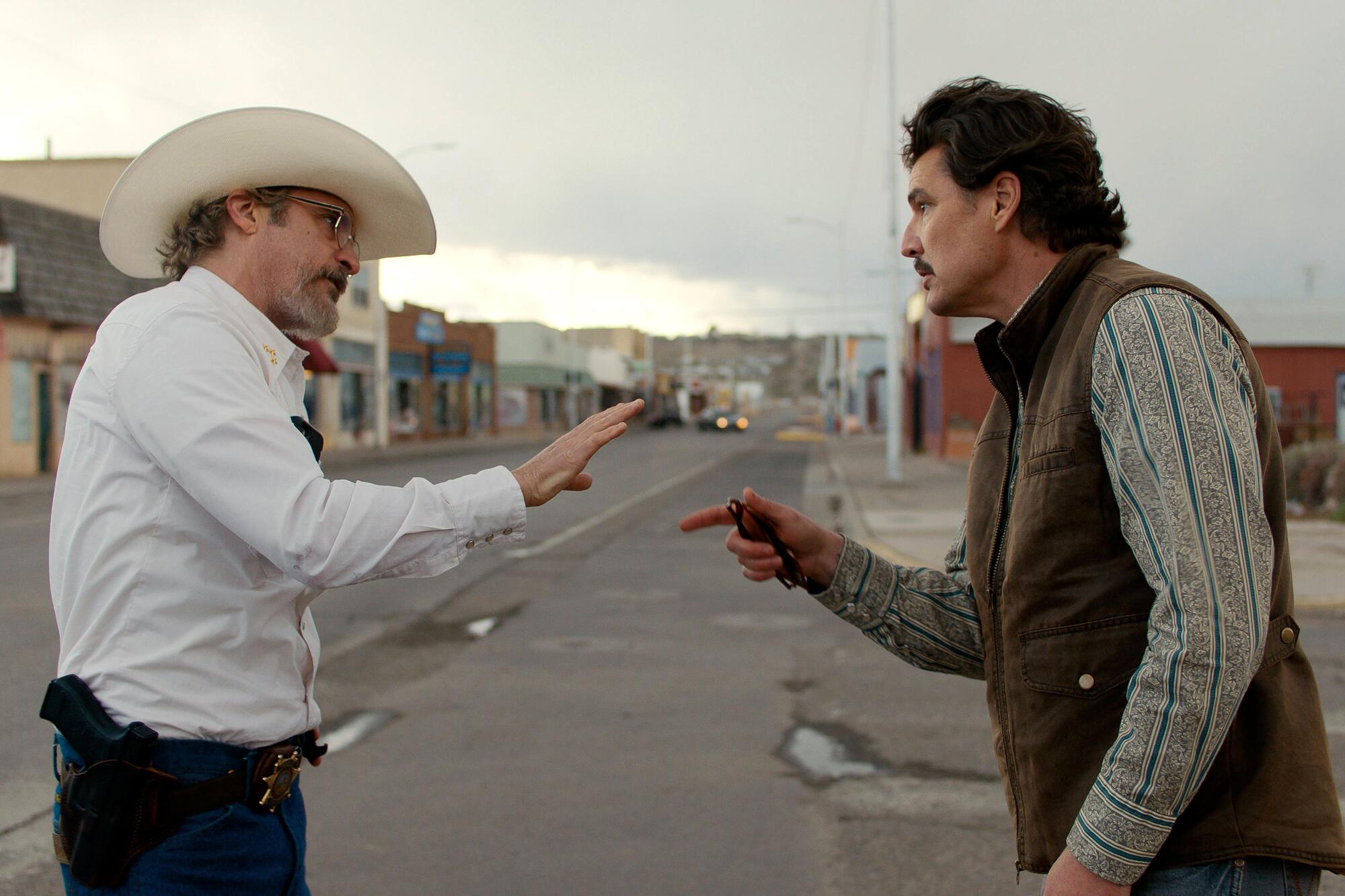

In Ari Aster’s Eddington, nothing is what it seems—not the small-town smiles, not the promises of politicians, and certainly not the perfectly pressed white shirt worn by Joaquin Phoenix’s Sheriff Joe Cross. Set against the stark backdrop of pandemic-era New Mexico, the film’s simmering tensions are mirrored in its costumes, which feel lived-in, dusty, and quietly revealing. At the heart of this painstakingly authentic visual world is costume designer Anna Terrazas, who dressed a star-studded cast that includes Phoenix, Emma Stone, Pedro Pascal, Austin Butler, and Deirdre O’Connell. Through thrifting, aging, and obsessively detailed choices, Terrazas crafted looks that disappear into the story—until you realize just how much they’re telling you.
Spencer Williams: Anna, I am so happy to chat with you. What an interesting film—we have a lot to get into.
Anna Terrazas: I’m happy to be here with you. Thank you for having me.
Spencer Williams: Of course. First, I’d love to hear about your collaboration with writer and director Ari Aster. Ari has such a fascinating body of work—from Midsommar to Hereditary to Beau Is Afraid. Whenever you approach one of his films, you can always expect something layered, interesting, sometimes comedic, and a little terrifying. What were your initial conversations with him like going into Eddington?
Anna Terrazas: When I first read the script, I had so many notes and questions for Ari. Even in the script, there are things only he knows the meaning of, so he really needed to walk us through what certain moments represented. That was essential for us to build the characters and fully understand the story.
Ari is a fantastic writer and director, and I felt very honored to work with him. From the beginning, he was open and collaborative, always answering questions and including us in decisions. It was a true partnership between all the departments—production design, cinematography, costumes, everyone.

Even once we were deep into the design process, Ari would add new details about the characters. For example, Louise’s artwork with the dolls: each doll meant something specific, and we needed to understand that in order to connect what she was creating to how she dressed. Those kinds of details came up constantly, and they were important in shaping every character, even the background ones.
Ari grew up in New Mexico, so he understood the social environment he wanted to portray. Eddington is a fictional small town, but it reflects the fabric of many small towns across America. He was clear about the town’s significance, which guided our research and designs.
Spencer Williams: That’s a perfect segue because I wanted to ask about New Mexico. Eddington is fictional, but I believe it was filmed in Albuquerque?
Anna Terrazas: We wrapped in Albuquerque, but most of the town was built in a tiny place called Truth or Consequences, which was perfect for the film. When I arrived in Albuquerque to start prep, I realized I needed to visit more than just Truth or Consequences because Eddington isn’t based on any single town—it represents many.
I did a lot of field research. Beyond books and photographers, I spent time in these communities, talking to people, observing how they lived, and photographing them. The way people dress and carry themselves is very specific there, and it’s completely different from, say, designing in New York.
It was my first time in New Mexico, and I wanted to immerse myself. I even moved there with my son for six months while working on the film—he went to school in Albuquerque during that time. That experience helped me understand what people liked, where they shopped, and how the community functioned, which directly influenced the costume design.
Spencer Williams: One thing I love about this film is the realism and authenticity. I’ve never been to New Mexico, but I felt like I knew this town. The people of Eddington feel so real. How much did thrifting play a role in costuming the townspeople?

Anna Terrazas: All of it.
Spencer Williams: All of it?
Anna Terrazas: Yes, thrifting was everything. I had no idea how incredible the thrifting scene in Albuquerque and New Mexico would be—it’s the best I’ve ever seen in America. People there really reuse things. Albuquerque only has two malls with a handful of stores, so thrifting is part of everyday life, which I think is fantastic.
That’s exactly what we leaned into for the film. We wanted the costumes to feel real, and thrifting was essential to achieving that. Even Joaquin and Ari later told me they loved how the costumes felt invisible—you don’t see “costumes,” you just believe in the characters. That was our goal, and thrifting made it possible.

We did add our own touches—fading colors, distressing fabrics—but most pieces were already worn. That helped us show how these characters lived. Some lived in cramped, chaotic environments like Dawn’s house, while others, like Joe, were meticulous and organized in their uniforms. Those contrasts were important.
Spencer Williams: You mentioned Joaquin and his love for the costumes, so let’s talk about the characters. Before we get into the complexities of each costume, how collaborative was the cast when it came to costumes?
Anna Terrazas: Fantastic. Everyone had input in shaping their character’s look. Joaquin and I, in particular, went back and forth for a long time. We debated whether his character, Joe, would wear a khaki uniform like other sheriffs or adopt a different look.

We researched sheriffs across New Mexico and eventually found one who inspired Joaquin. His style influenced Joe’s costumes, but we adapted it. Ultimately, we decided to keep Joe in a crisp white shirt and jeans throughout the film. That single, clean silhouette became a visual anchor as his character’s arc progressed—starting pristine, then gradually becoming worn, dirtied, and bloodied.
It also made him stand out. He was the only person in white against the desert backdrop, which added to the tension. The white shirt made Joe feel approachable, like a friend, but he was still clearly an authority figure.
Spencer Williams: That’s fascinating. Joe feels like the most emotionally complex character, yet he’s grounded in Eddington in a way other characters aren’t. Take Pedro Pascal’s character, Ted Garcia, the mayor—he’s from the town, but he reads as “the politician.” How did you approach his costumes?

Anna Terrazas: We researched all the mayors in New Mexico. Ted is a politician, but we wanted to hint that he may not have chosen this role for himself. He’s a bit of a puppet, told what to say and do, but he still wants to connect with people.
Finding the balance was tricky. Some images we found of real mayors felt like the stereotypical politician—ties, pressed suits—but we didn’t want that.
Spencer Williams: For me, it’s the vest.
Anna Terrazas: We tried so many vests for Pedro, but as soon as he started trying things on, he felt it—he said, “This is it. I feel Ted now.” We debated whether he should wear a tie, but ultimately a bolo felt right. We wanted him to read as a politician, but still approachable within this town.
Spencer Williams: Yes! I loved the vest. When I saw him, I immediately thought, “This is someone who’s being told how to be a politician,” which really added to the subtle horror and comedy of the film.
Anna Terrazas: Exactly. There’s comedy in it. Take the scene where Ted’s on Zoom, turns around, and mutters, “I can’t stand this woman,” before quickly composing himself. There’s always someone telling him what to do, and that was important to us—it reflects the world we live in.

Spencer Williams: Terrifying. Speaking of terrifying, another space you mentioned earlier was Joe and Louise’s house, which felt so cramped. I want to talk about Emma Stone’s character, Louise. She seems like someone barely holding it together—isolated at home, consumed by the internet, and influenced by a new person entering her life. Her costumes felt like subtle windows into her state of mind. How did you approach designing for her?
Anna Terrazas: When I read her character, I immediately saw clues in her artwork. As I mentioned before, Ari fostered great collaboration between departments, and Louise’s dolls helped guide how she should be dressed. Her art was her only real form of self-expression.
Inside the house with Joe and Dawn, Louise is introverted, silenced, and fragile. She wears oversized sweaters and layers that hide her body, like another doll. We wanted the audience to focus on her hands—the only part of her truly “seen”—as they created the dolls. Her clothing conveyed depression: long, heavy garments, unkempt hair.
The moment she leaves the house to meet Vernon, she changes. She shows more skin because she’s putting herself together for him. That progression continues until the end of the film, when she cuts her hair, shows her tattoos, and wears clothes that reveal confidence. She metaphorically “gets naked” in front of the town, finally able to speak for herself despite everyone thinking she’s crazy.
Textures were also important. Many of the dolls were made from pieces of Louise’s clothing—fragments of her sweaters, skirts, or other fabrics. We collaborated closely with the art department, sharing materials so her costumes and dolls visually connected.
Spencer Williams: Wow. I actually had a note about that collaboration. You worked with production design and the art department to produce clothing for the dolls themselves, right?
Anna Terrazas: Yes. I really believe you can tell when all departments have collaborated because the film feels cohesive. When that communication doesn’t happen, it shows.
For me, it’s essential to work as a team. We talked with the cinematographer about how things would be lit, and with production design about the color palette of the house. We needed to know what the sets would look like so we could decide when to blend actors into the background or pull them out visually. That collaboration is something I always prioritize when designing.
Spencer Williams: Let’s talk about Vernon, played by Austin Butler. He’s a spiritual leader stirring up controversy online. The second I saw him, I felt a chill—he reminded me of Charles Manson–type cult leaders. It was subtle, but the way he looked so pristine and put together compared to everyone else was unsettling. Tell me about building his look and your inspirations for giving him that provocative yet charming presence.

Anna Terrazas: You nailed it. We researched every cult and spiritual leader we could, both past and present. At one point, we experimented with making Vernon look more “lost in time,” but it felt too similar to the people of Eddington and didn’t create the contrast we wanted.
I worked closely with Austin, who also dove into the research. We decided Vernon needed to feel like he was “bringing light” into Louise’s life. When he first enters the house, his shirt even shares a subtle texture connection with hers—he’s already infiltrating her world.

It was important to establish him as the outsider. No one in Eddington dresses the way he does. By the end, when he’s in that immaculate white suit, it’s even clearer. He’s a beacon of hope—or so he wants people to believe—while everyone else still looks like they’re from a small Midwestern town.
Spencer Williams: That pristine presence was hilarious but also terrifying. Honestly, Austin Butler could pull off being a cult leader—he sold it.
Anna Terrazas: Completely. During the rally scenes, watching him command the stage, I thought, “You’re scaring me—you could really be this person.” We watched so many unsettling YouTube videos of real-life leaders, and one thing that stood out is how expensive their clothes often are. We wanted Vernon to carry that same energy: polished, aspirational, and inviting, while saying, “Come to me, I’ll help you.”

That thread ties into the three central male characters: each is approachable and open in his own way—a politician, a police officer, and a spiritual leader.
Spencer Williams: And at that point in the film, Vernon is standing next to Louise, who looks the happiest we’ve ever seen her—pregnant and glowing. Honestly, I was a little happy for her by then.
Anna Terrazas: That was the point. We even joked on set, “Can we please shoot this so she can have a little happiness?” because so much of her story is filled with depression and isolation.
Working with Emma was wonderful. I usually prepare concept drawings and presentations for actors, and she immediately connected with them. During fittings, we initially tried a few looks that felt wrong—too exaggerated—but we quickly found the right track. Emma said it was the easiest, fastest fitting of her life, which I took as a big compliment.

Spencer Williams: Especially coming from someone who was in Poor Things! One thing I really love about Eddington is the worn-in, lived-in quality of the costumes. You can feel the dirt, sweat, and later the blood. Can you talk about the aging and dyeing process your team went through?
Anna Terrazas: Aging and distressing the costumes was one of the most important elements for me. I rarely use new clothes, but for this film, we needed to take it even further. Before I even arrived in Albuquerque, I was already looking for the best local crew to handle aging and dyeing. The desert is a character itself in this film—the dust, the sun, the dryness—so we had to reflect that in the clothing.

After spending six months there, you realize how quickly the environment clings to you. You’re out shooting all day and return home covered in layers of dust. We needed to build that into every uniform, every pair of shoes. Even though many pieces were thrifted, we still washed them, painted them, and added dirt.

The same went for Ted’s jeans and the backgrounds. Even if he looked more pristine, we distressed everything to feel authentic. We dressed every background actor and gave them the same dusty, worn-in quality. My goal was for audiences to almost “smell” the clothes, to feel like they needed to brush the dirt off themselves after watching.
I had a fantastic crew who worked incredibly hard on this. Of course, there were stressful moments, but we pulled it off.
Spencer Williams: It’s important to remember this story is set during a global pandemic, too. No one was going out and buying new clothes at that time.
Anna Terrazas: Exactly. We had to think back to those days: when you went to the grocery store, you weren’t dressing up. You weren’t putting on your best jeans; you’d be in sweatpants, messy hair, maybe a baseball cap and a mask.
There’s even a scene outside a supermarket where people are lined up. Right before shooting, Elliot, our production designer, and I were both staring at the same background actor’s shoes. They were far too clean. We swapped them out because every little detail mattered—it couldn’t look like anyone was in their “Sunday best.”
Spencer Williams: Exactly—baseball hat, mask, sweatshirt, and go.
Anna Terrazas: Yes!
Spencer Williams: Anna, this has been so fun. Eddington is such a unique film, blending Western aesthetics with comedy and deep emotional themes. It also captures a moment in our lives that was only a few years ago but still feels so fresh. As we wrap up, what does Eddington mean to you personally, and what do you hope audiences take away?

Anna Terrazas: For me, the film speaks about our modern world and where we’re heading. I hope it inspires humanity to care for one another again and to step away from our phones and constant distractions. We’re becoming like machines, reacting immediately to news without taking the time to think or understand.
I hope this film makes people stop and reflect—not just about themselves, but about others, even those on the other side of the world. Ari is a master at showing us modern America, but it’s bigger than that—it’s about the entire world.
Ultimately, I hope it gives people a sense of hope. When I finished the film, it took me a while to process because it’s so emotional. We were laughing, crying, feeling everything—just like in everyday life. Right now, the world feels so self-protective, so isolated, and I want audiences to remember to turn around, help each other, and connect.

COVID made us distance ourselves, literally and emotionally, and I think we’re still living with that. This film is a reminder to reach out, to hug someone, to push back against the negativity and division.
Spencer Williams: Beautifully said. Eddington is an incredible film, and I hope everyone goes to see it. Honestly, I’m ready to watch it again now that I know even more about your process.
Anna Terrazas: Me too!
Spencer Williams: Thank you so much, Anna. This has been such a joy.
Anna Terrazas: Thank you, Spencer. I’m so proud of the film and so grateful to A24, Ari, the cast, and my amazing team. I hope audiences love it as much as we loved making it.

