
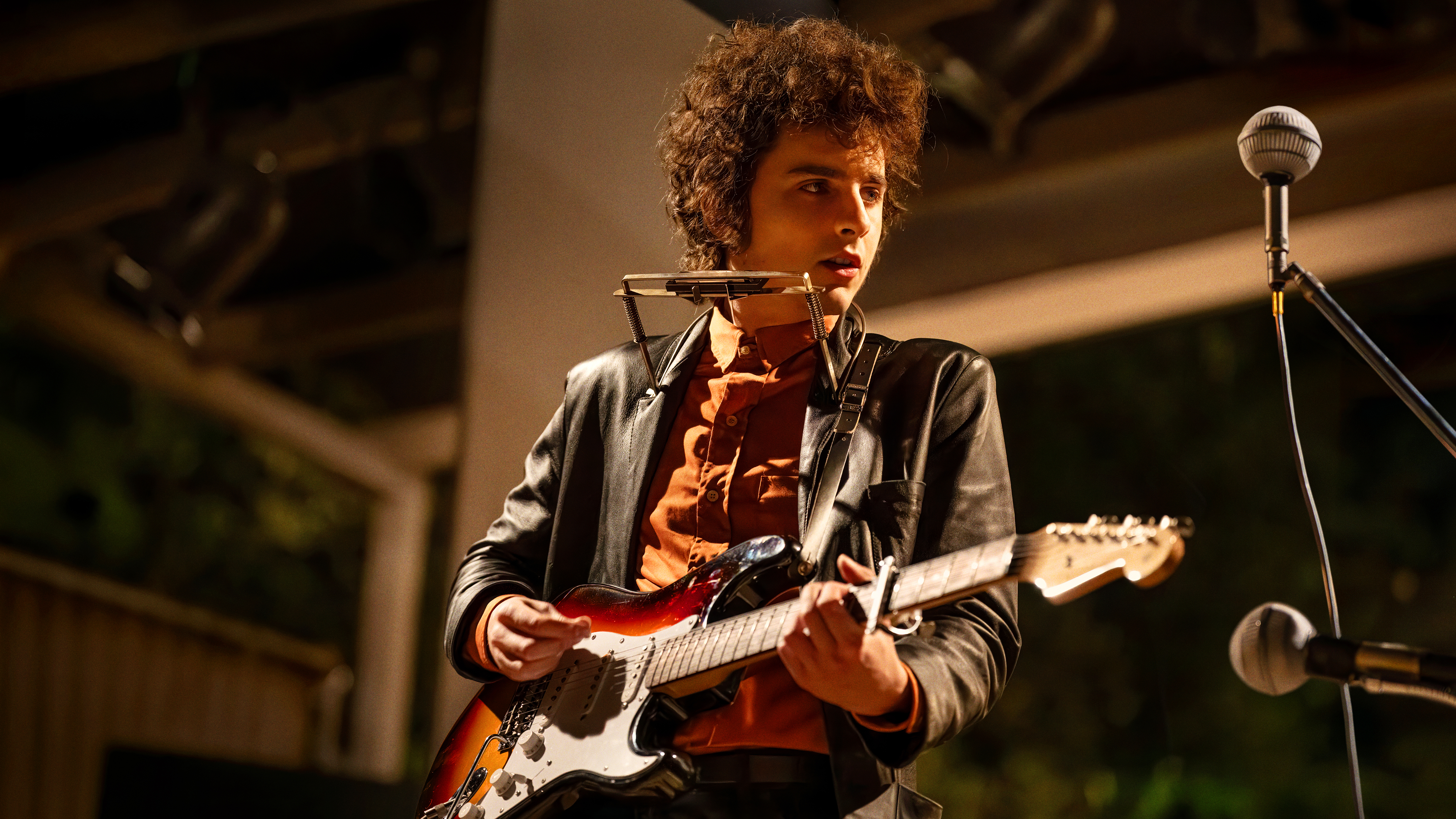

In this exclusive interview, Academy Award-nominated costume designer Arianne Phillips takes us behind the scenes of A Complete Unknown, the highly anticipated Bob Dylan biopic directed by James Mangold. Phillips delves into the intricate process of recreating the early 1960s, using costumes to capture the essence of Dylan’s transformation and the cultural shifts of the era. She reflects on the film’s universal themes of hope, humanity, and individuality, exploring how art and creativity serve as bridges across generations. Highlighting the collaborative spirit of her dedicated team, Phillips shares the challenges and triumphs of designing for a film that celebrates one of music’s most iconic figures. This conversation reveals the artistry, passion, and purpose behind what is sure to be one of the year’s most memorable films.
Spencer Williams: I am so excited to finally welcome someone I’ve wanted to interview for a long time—costume designer Arianne Phillips!
Arianne Phillips: Hi Spencer. I’m so happy to be here with The Art of Costume. Thank you so much for supporting our craft. I really love listening to your interviews, so I’m thrilled to be here. Thank you.
Spencer Williams: That’s so sweet. Well, I mean, we’ve talked about you on the podcast quite a bit. We did an episode on Don’t Worry Darling, which was one of our favorites. I also talk about Once Upon a Time in Hollywood all the time. So this is very exciting, and I’m especially thrilled to discuss A Complete Unknown.
To start, we obviously have to discuss the research. I was fascinated to learn about the amount of time you had leading up to this project, even if unintentional. Let’s dive into how it all came together in the beginning. Were you already a big Bob Dylan fan?

Arianne Phillips: Absolutely. Bob Dylan has been a part of my life for as long as I can remember. My parents had his albums when I was a kid, and it was our Sunday morning music—pajamas, pancakes, and dancing around the house. I have such early, vivid memories of listening to his music.
As I got older, his work continued to resonate with me—his music from the ‘70s, the Traveling Wilburys, and so on. I’ve seen him in concert many times. Whether or not someone is a big Dylan fan, most people know his music because he’s one of the most covered artists in history.
It’s incredibly exciting to be part of a film that evokes such nostalgic and emotional memories for people. And it’s thrilling to help introduce his story to a new generation, a younger audience that might not be as familiar with his work.

For me, working on this project was also about reuniting with Jim Mangold. This is my sixth film with him, but it’s been ten years since our last collaboration, simply because our schedules hadn’t aligned. He first reached out to me about this movie in 2019, and honestly, I’d follow Jim off a cliff. He’s one of my most valued collaborators.
I’ve felt incredibly appreciated on every project we’ve worked on together, starting with Girl, Interrupted and now with A Complete Unknown. Almost 20 years ago, we worked together on Walk the Line, which was my first experience delving into the world of Johnny Cash. During my research for that film, I learned about Johnny Cash’s surprising friendship with Bob Dylan.

At first, I thought of them as very different artists, but their connection makes so much sense. They’re both quintessentially American artists who refused to conform to what managers, executives, or marketing teams thought they should do. They made the music they wanted to make, often against the odds.
For example, Johnny Cash’s insistence on performing at Folsom Prison reflects that independence. They’re true iconoclasts—once-in-a-generation artists who refused to be boxed in or defined by a single identity. That’s something I deeply admire and relate to in my own career.
I’ve worked across different mediums—fashion, music, theater—before focusing on film. Another artist I’ve worked closely with, Madonna, shares that same fiercely independent spirit. Like Dylan and Cash, she refuses to be confined by expectations. Her focus on authenticity and artistic expression resonates deeply with me.
So being part of A Complete Unknown felt incredibly meaningful. Jim reached out in 2019, but the film was delayed due to COVID and scheduling conflicts. It was supposed to start in 2020, but the pandemic caused a false start, and then it took time for everything to align—Timothée’s schedule with Dune, Jim’s work on Indiana Jones, and so on.

Even though I wasn’t officially prepping during that time, I kept folders of images and ideas on my computer, gathering inspiration while we waited. We finally started production in 2023. I began in Los Angeles because Timothée and Monica were rehearsing and recording music here, so it made sense to do early fittings nearby.
The story is set during a very specific period—1961 to 1965—which gave me time to immerse myself in the details of that era. Unlike typical biopics that span decades, this film focuses on just four years. That precision was both a challenge and an opportunity for the costumes.
Spencer Williams: That’s so fascinating.
Arianne Phillips: It really was. The film moves through a variety of locations and scenarios, but the time period remains consistent. There’s no dramatic shift in technology, architecture, or cars. Instead, the focus is on Bob’s evolution—his character arc as a young man arriving in Manhattan in search of his hero, Woody Guthrie.
The story starts with him fresh off the bus from the Midwest, not knowing anyone, and it ends with his iconic electric performance at Newport.
Spencer Williams: It feels like Bob Dylan evolves into almost a completely different person by the end of those four years in your story.
Arianne Phillips: Those four years mark such a pivotal period in his life—it’s where we really see him finding his artistic voice and becoming the Bob Dylan we know today. That transformation was both daunting and exciting to capture, especially through costume and hair. My goal was to take the audience on a journey, making it an immersive experience that reflects Bob’s evolution.
A huge part of that transformation was realized through the hair design by Jamie Lee McIntosh, who’s brilliant. I was fortunate to work with her again after collaborating on Don’t Worry Darling. The costumes, of course, played a vital role too. It was a massive undertaking—Timothée Chalamet had about 67 costume changes, and we had over 120 speaking roles with principal characters averaging anywhere from 8 to 30 changes each. Beyond that, we dressed 5,000+ extras, which required amassing an extensive wardrobe.

Research was key to achieving authenticity. I created a comprehensive digital “bible” to document the chronological story of Bob’s journey from 1961 to 1965. This included known events we recreated, like his performances at Newport, and references to notable figures like Johnny Cash, Joan Baez, and Pete Seeger. It also included characters who aren’t directly featured but were present in the scene’s historical context, such as Odetta and Lightning Hopkins.
We broke Bob’s transformation into three distinct beats: his arrival in New York (1961-62), the Freewheelin’ era (1963-64), and the slim, mod silhouette of 1965. These beats informed everything—the costumes, hair, and overall silhouette. For example, the early ‘60s silhouette was looser and baggier, whereas the mid-‘60s style became more streamlined and modern.
We started fittings with Timmy, Monica Barbaro (Joan Baez), and Elle Fanning (Sylvie) early in 2023, but the actor’s strike paused production just two weeks before shooting. While the delay was stressful, it gave me time to refine the prototypes and plan the builds. I spent that time in quiet reflection, listening to music and immersing myself in research to ensure every detail was intentional.

Spencer Williams: That intentionality really shows in your work. But I wanted to ask—Bob Dylan, as a public figure, is so well-documented. How did you approach capturing his private side? There are moments in the film where it’s just Timmy in his apartment with his guitar. How do you identify what the private Bob Dylan might have looked like?
Arianne Phillips: That’s a great question, Spencer. We faced a similar challenge on Walk the Line, where we had to balance Johnny Cash’s onstage persona with his private life. With Bob, we didn’t have access to personal photos either, but Jim Mangold, our director, gave us the creative freedom to build something cinematic rather than purely documentary.
To capture Bob’s private side, I immersed myself in the photographic evidence we did have. Thankfully, he was widely photographed during this time—newsreels, candid moments, and the Columbia Records archive were invaluable. The archive gave us access to behind-the-scenes shots, not just the polished images released to the public. These candid photos gave a real sense of Bob’s offstage aesthetic and helped inform how he interacted with other characters, like Tom Wilson, Albert Grossman, and Joan Baez.

We’re not aiming for a one-to-one recreation but rather an interpretation that captures his essence. For his private moments, it was about blending the details of his documented aesthetic with the overall narrative we were telling.
Spencer Williams: Oh to be in Bob Dylan’s head… would be quite the adventure if only we could have a few moments there! There are so many unique costume moments I want to discuss, but before diving into Bob’s looks, I want to touch on Johnny Cash for a moment. Obviously, you worked on Walk the Line, for which you were nominated for an Oscar. As you know, his look is iconic and well-documented. However, in A Complete Unknown, it felt like there was a blending of the actor and the historical figure that wasn’t an exact replication. How do you approach designing costumes for a character you’ve already tackled before—especially when balancing accuracy and the actor’s own physicality?
Arianne Phillips: It was such a gift to revisit Johnny Cash with a different actor and a fresh perspective. Each actor has a unique physicality, so a lot of the early process involves trying on vintage pieces to see what works proportionally for their body. Boyd Holbrook was a wonderful collaborator, and he really embodied Johnny during this particular period.
This was a time when Johnny Cash was known for his lean frame, partly due to his amphetamine use. Working with Boyd, we explored physical augmentation to capture Johnny’s silhouette authentically. That approach wasn’t limited to Johnny either—we did the same for Timothy, Joan Baez, and Pete Seeger.
Johnny’s costume at Newport is very well-documented, so recreating it was straightforward. But we also crafted additional pieces to show his state of mind, like the outfit he wears on the airplane and the one from the morning after his crash. These moments required careful thought about what felt authentic to Boyd as Johnny.

Johnny Cash had such a significant influence—not just on Bob Dylan artistically but also in terms of style. Bob’s wardrobe in 1965 leans into darker colors, but there are hints of vibrancy, like the orange and polka-dot shirts. These looks foreshadow Bob’s transition to the mod-inspired outfits of 1966 and 1967, when he started having clothes made in England, drawing from the British invasion.
Spencer Williams: Speaking of Newport, I wanted to ask you about Joan Baez and that coat she wore at the end of the festival. It’s such a great piece.
Arianne Phillips: That was one of my favorite pieces, Joan Baez’s coat in her final scene. Joan had such a unique style—modest, almost puritanical, yet distinctive. She avoided sexualizing her image, often wearing understated pieces. Her wardrobe at Newport 1964, for instance, included a white dress with a bow and a suede fringe jacket.

But her vinyl coat was a mystery. I first noticed it in black-and-white images from Newport 1965 and again on the cover of her Farewell, Angelina album. Initially, I thought she acquired it during the photo shoot, but later, I found a photograph of her wearing it at an anti-war rally in London. This led me to research its origin, eventually uncovering that it was a Mary Quant design—part of her collaboration with a raincoat company to produce affordable, high-street pieces.
We recreated that coat for the film, choosing a neutral taupe color with an orange lining to evoke Mary Quant’s mod sensibilities. It was a fascinating journey to bring this piece to life because it encapsulated Joan’s youth and individuality during that time.
Another favorite piece was the dress worn by Sylvie during the ferry scene. That moment is so emotional—Sylvie’s vulnerability and the tenderness between her and Bob. I wanted the dress to reflect that sweetness, but finding the right design was challenging. After sourcing vintage fabrics, I finally found a contemporary fabric based on an archival Marimekko print. Its watercolor-like quality felt evocative, almost like a Rothko painting, and perfectly captured the emotion of the scene.

Spencer Williams: I have two costumes that made my favorite moments. The first one is the very first shot of Timmy when he gets off the bus or cab, and he has this big scarf. It doesn’t look tattered, but you can tell this young man has already had quite a journey. Even though you don’t explicitly say that in the film, you can feel it in the costume. Was that intentional, to give the vibe that he’s been traveling for a while and lived a bit of a life already?
Arianne Phillips: Yeah, that was absolutely intentional. The idea was for it to feel well-loved and well-worn. Considering he only has a backpack and is likely wearing the same thing every day, he’s kind of a messy 19-year-old boy, even though everything about him is very considered. One of the insights I picked up from reading Suze Rotolo’s book—the real-life inspiration for Sylvie, Elle Fanning’s character—was that this Woody Guthrie-inspired look Bob Dylan wore in his early days was very curated and thoughtful. That was fascinating to learn because it highlights how much thought Dylan put into how he presented himself.

At 19, you’re just leaving home and stepping into the world as an adult. You’re making your own decisions about who you want to be, who you identify with, and how you want to present yourself. For Dylan, coming to New York was about pursuing his dream of meeting Woody Guthrie and chasing something deeply important to him as a songwriter. He fashioned himself after his hero.
When I was 19, I moved to New York. Even though I was born there, I grew up in California. I remember fashioning myself after Bananarama, figuring out my own style. That journey of discovering our personal style is such a vital part of figuring out who we are. Dylan’s look at the time—Pendleton shirts, dungarees, and those working-man painter pants—was a tribute to everything Guthrie represented: Americana and the working class.
In the story, it’s really about Dylan finding his identity, not just as an artist but also in his relationship to the world and how he wanted to present himself. We learn a lot about people by how they dress themselves. That was something I enjoyed exploring in this film. And I have to credit Timmy for pushing me hard on the aging and wear of the clothes. He wanted everything to feel really lived-in, and I was so thankful for that. We kept aging his clothes throughout the film, often throwing continuity out the window.
The way Phedon Papamichael, our cinematographer, lit the film—with a lot of practical and natural lighting—gave it a warm, underlit feel. This really helped us push the textures in the costumes. Everything looks cleaner on camera, so we had to test and see how far we could push it. In the end, it worked, and I think Timmy would be happy to know his attention to that detail was noticed.
Spencer Williams: That’s incredible. Please pass on my regards and let Timothée know I am available for a hang. I have to bring up one more costume. I thought it was such a genius moment that perfectly illustrates why costume designers are storytellers. Toward the end of the film, Bob is talking to his bandmates, and one of them is wearing a polka-dot shirt. Bob makes a comment about it, calling him a clown. Then, when we see Bob the next morning, he’s wearing the polka-dot shirt!
Arianne Phillips: Oh, I love that observation! So here’s the story behind that shirt. Bob Dylan actually wore a similar polka-dot shirt during soundcheck at Newport, which was documented. Jim added the earlier scene where the band buys the shirts in a store to set that up. The idea was to present a cohesive look for the band, since Dylan was headlining.

Jim initially thought the shirt might be too much, but the research showed Dylan liked polka dots. It became part of his style throughout the ’60s and even later. The colorized version of an obscure album cover revealed that the shirt was green with polka dots, which Jim found crazy but intriguing.
The choice for Timmy to wear the shirt in that bed scene wasn’t scripted. Timmy suggested it during rehearsal, and we loved the idea. It wasn’t a carefully considered costume choice—it was just Bob pulling on what was closest to him. But your interpretation of it as clownish, as a precursor to the chaos of the festival, is fascinating. That’s the beauty of filmmaking. These little details take on new layers of meaning through the audience’s perspective.
Spencer Williams: It really felt like a precursor to the circus that was about to unfold that night. Even though it was such an incredible moment in history, there was this chaotic, almost absurd energy to it.
Arianne Phillips: That’s such a great observation. I love it.
Spencer Williams: I still have about 2,000 more questions, but we’re out of time. Before we go, what do you hope audiences take away from A Complete Unknown, and what did this film mean to you?

Arianne Phillips: Ultimately, what I take away from the film is what I hope others will take away as well. Generationally, I hope this film reaches people who may not know much about Bob Dylan or perhaps aren’t familiar with his music at all. What stands out to me is how it reflects the cyclical nature of our world. We often feel like we’re living through unprecedented times—whether during wartime or facing social struggles—but the truth is, these challenges have persisted across generations. The racial injustices, wars, and societal fractures we face today mirror those of 1961 and 1965.
What I find so inspiring—and what I hope viewers take from this film—is that creativity and art have always been a way to unite us. They offer hope, reflect our humanity, and remind us of our capacity for resilience. As human beings, we are so complex and multifaceted. By embracing creativity, community, and connection, we ensure humanity continues to evolve. There’s a profound sense of hopefulness in understanding that change is constant and inevitable, and through that change, we can grow and adapt.
On a more personal level, I hope the film encourages people—artists and anyone with a sense of purpose—not to feel defined by a single role or by others’ perceptions of them. It takes bravery to live authentically and pursue your own truth, much like Bob Dylan and Johnny Cash did, along with so many other great artists who’ve shaped our culture. Individuality and humanity are everything, and this film celebrates those ideals.
Spencer Williams: That’s such a beautiful sentiment, Arianne. I feel like all of that really shines through in this film. It’s truly one of my favorite films of the year. Congratulations! And of course, thank you so much for joining me today. This conversation has been such a joy.

Arianne Phillips: Thank you, Spencer. And before we wrap up, I just want to give a huge shout-out to my incredible crew. Felicia Jarvis, my assistant costume designer, along with Katie Hartsoe and Amanda Seymour in New York, who were my amazing ACDs. I had a fantastic team of additional costume designers out there. Kate Edwards, my brilliant supervisor, and an extraordinary set crew, including Ana Perdita, Sarah Schaub, Brandon Curry, and Melissa Tulski. Plus, our amazing aging team, fitting crew, and background costumers.
This project truly took a village. Every single one of these talented individuals came back to the film after the strike, even when they had other opportunities. It was a passion project, not just for those of us above the line but for everyone involved. It was truly a once-in-a-career experience, and I’m incredibly grateful for it. Thank you for giving me the chance to share this journey.
Spencer Williams: Of course. Thank you again, Arianne. It’s clear this film was made with so much love and dedication.
Arianne Phillips: Thank you, Spencer.

