
Even from the dark depths of space, one could hear the blood-curdling screams of film and costume fans as The Horror Show opens to thunderous applause at the Academy Museum of Motion Pictures. Beginning September 26, 2026, visitors can step into one of cinema’s most enduring and evocative genres as the highly anticipated exhibition takes over the museum’s fourth-floor gallery in spectacularly bloody fashion.
The Horror Show is not simply a gallery filled with random artifacts tucked away behind glass, waiting to see if audiences recognize them. Instead, Senior Exhibitions Curator Jessica Niebel, alongside Nicholas Barlow and Alexandra James Salichs, invites visitors on a carefully constructed journey through horror’s storied history. Across six distinct chambers, the exhibition examines the many ways horror has frightened, fascinated, challenged, and ultimately connected audiences. Each thematic space is packed with rare original props, costumes, production materials, and interactive displays that bring the genre’s most unforgettable worlds to life.

Image Credit: ©Academy Museum Foundation, Photo by: Emily Shur.
The Horror Show is an exploration of horror’s emotional, cultural, and symbolic power and examines why horror matters so deeply to many different types of communities. – Jessica Niebel, Senior Exhibitions Curator
Perhaps the most exciting aspect of The Horror Show is the experience of walking into each thematic gallery and being met with some of the most sinister, unexpected, and thrilling surprises.
The Gothic chamber immediately sets the tone, exploring one of my favorite corners of the horror genre. Visitors are greeted by the unmistakable silhouette of Bela Lugosi’s cape from Dracula (1931), recently restored and looking as haunting as ever. Frankly, that alone might be worth the price of admission.

Image Credit: ©Academy Museum Foundation, Photo by: Emily Shur.
But the real draw for every costume nerd will be the one-on-one encounter with Eiko Ishioka’s iconic armor, created for Gary Oldman in Bram Stoker’s Dracula (1992). I feel no shame in admitting that this goth shed a tear or two upon encountering this extraordinary piece in person. Seeing Ishioka’s work up close is a reminder of just how powerful costume can be when it becomes an extension of character, world, and mythology.
And the surprises keep coming. Moving through the gallery, visitors will encounter costumes and props from Interview with the Vampire (1994), Blade (1998), Horror of Dracula (1958), and The Hunger (1983), alongside more recent additions from Sinners (2025), featuring costumes designed by Ruth E. Carter, and Nosferatu (2024), with costumes by Linda Muir.
Costume can often give audiences clues to understanding a character’s twisted psyche, and the Psychological chamber demonstrates this perfectly. Costumes from films such as The Shining (1980), designed by Milena Canonero, Misery (1990), designed by Gloria Gresham, and The Silence of the Lambs (1991), designed by Colleen Atwood, demonstrate how clothing can become a visual window into a character’s mind. From isolation and obsession to fear and control, these costumes help communicate psychological horror before a character even speaks a word.

Image Credit: ©Academy Museum Foundation, Photo by: Emily Shur.
No horror exhibition would be complete without witches, and The Horror Show takes a deep dive into stories that explore power, belief, the human body, and female strength. The Religious chamber is sure to be another fan favorite, anchored by the iconic flower-covered Midsommar (2019) dress designed by costume designer Andrea Flesch. There is something almost otherworldly about seeing this enormous, intricate piece in person. It is the kind of costume that stops all manner of time when you are in its presence.
And if that weren’t enough, the Midsommar dress is joined in sisterhood by the Aunt Gladys costume designed by Trish Summerville for Weapons (2025), as well as the famous costume worn by Tilda Swinton in Suspiria (2018), designed by Giulia Piersanti. Together, these costumes offer a fascinating look at the ways horror can use clothing to explore femininity, transformation, ritual, and power.

Image Credit: ©Academy Museum Foundation, Photo by: Emily Shur.
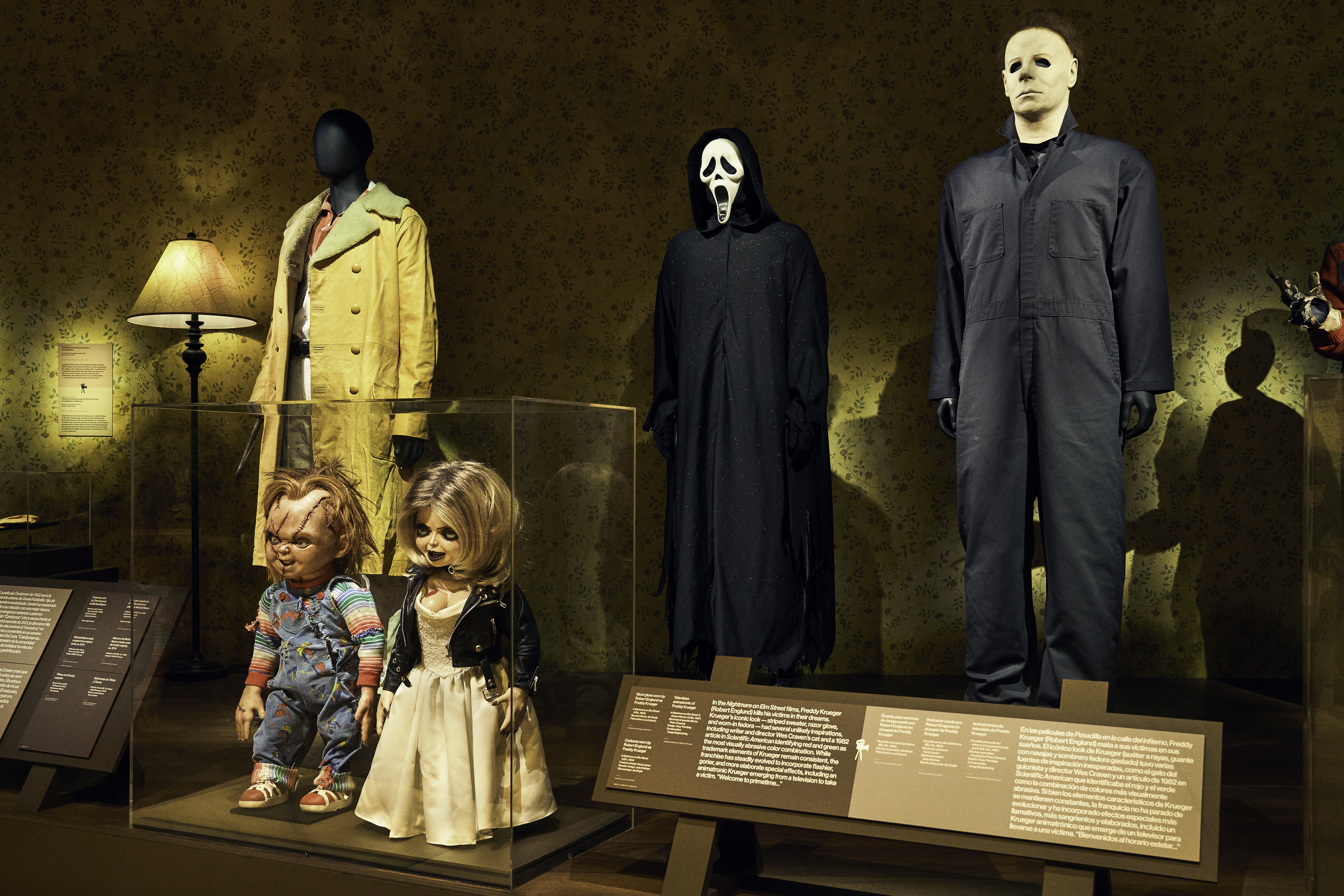
Other chambers within the exhibition continue to explore horror from wildly different perspectives. The Science chamber features a larger-than-life Xenomorph from Alien: Romulus (2024), while the Ghosts chamber is filled with spectral and supernatural encounters connected to films such as The Conjuring (2013) and The Blair Witch Project (1999). And, of course, there is the Slasher chamber, where visitors come face-to-face with Michael Myers from Halloween (1978) alongside a cast of nightmarish characters from films including A Nightmare on Elm Street (1984), Saw (2004), and The Texas Chain Saw Massacre (1974).
The Horror Show proves that beneath the gore, the fangs, and the voices speaking to us through creepy dolls and staticky televisions, horror may be one of cinema’s most powerful forms of storytelling. At its best, the genre does more than frighten us. It gives shape to our fears, reflects the anxieties of our culture, and tells stories that can resonate with audiences in deeply personal ways.

Image Credit: ©Academy Museum Foundation, Photo by: Emily Shur.
Brave the nightmare and visit The Horror Show at the Academy Museum of Motion Pictures beginning September 26, 2026, through July 2027, and encounter the images, costumes, characters, and stories that have defined and transformed horror cinema across generations.
The Academy Museum is open six days a week, from 10 a.m. to 6 p.m., and is closed on Tuesdays. Please note that The Horror Show contains material that may not be suitable for all ages and may be disturbing to some visitors. Parental guidance is advised, and visitor discretion is encouraged. The exhibition also contains elements that may trigger seizures in visitors with photosensitive epilepsy.

